Emotional Eating vs. Physical Hunger: How to Tell the Difference
Have you ever found yourself reaching for food when you’re not physically hungry? After a stressful day, during boredom, or even as a reward? You’re not alone. Eating is not just biological, it's deeply emotional, psychological, and environmental.
Understanding the difference between emotional eating and physical hunger is one of the most powerful tools for improving your relationship with food, supporting weight management, and enhancing overall well-being.
What Is Physical Hunger?
Physical hunger is your body’s way of signaling that it needs energy to function. This process is tightly regulated by a complex system involving the gut, brain, and hormones.
Two key players:
Ghrelin (“hunger hormone”): increases before meals to signal it’s time to eat
Leptin (“satiety hormone”): signals fullness and helps stop eating
These hormones communicate with the hypothalamus in the brain to maintain energy balance.
When functioning properly:
Ghrelin rises → you feel hungry
You eat → ghrelin decreases
Leptin rises → you feel full
This feedback loop is essential for survival and energy regulation.
Signs of Physical Hunger
Physical hunger tends to be:
Gradual (builds over time)
Felt in the body (stomach growling, low energy, brain fog, sleepy)
Flexible (any food sounds good)
Satisfied after eating
What Is Emotional Eating?
Emotional eating is driven not by physiological need, but by the desire to cope with emotions both positive and negative.
Common triggers include:
Stress
Anxiety
Boredom
Loneliness
Reward or celebration
Rather than fueling the body, emotional eating is an attempt to change how we feel.
Interestingly, emotional eating is also tied to the brain’s reward system. Highly palatable foods (especially those high in sugar and fat) activate dopamine pathways, temporarily improving mood, reinforcing the behavior over time.
Emotional vs. Physical Hunger: Key Differences
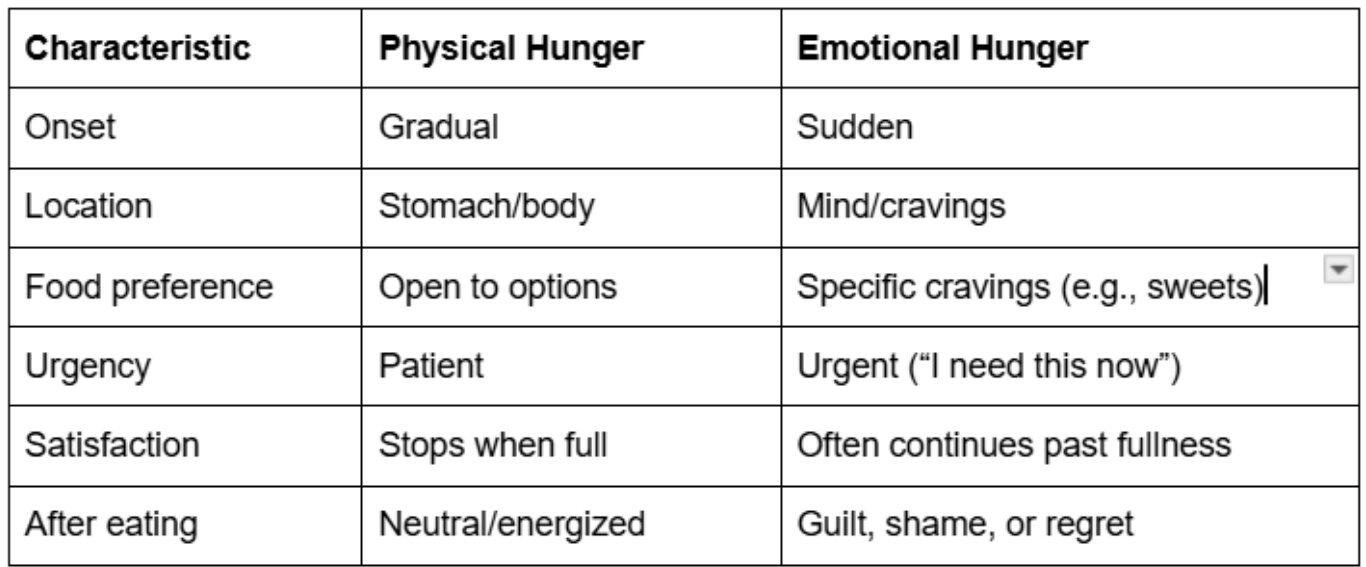
Research and behavioral observations consistently show that emotional hunger is more impulsive and cue-driven, while physical hunger follows biological rhythms.
Why the Lines Get Blurred
In real life, the distinction isn’t always clear and that’s normal.
Several factors can blur the line:
1. Hormonal Dysregulation
Stress, sleep deprivation, and dieting can disrupt ghrelin and leptin, making hunger cues harder to interpret.
2. Food Environment
Constant exposure to food cues (ads, social settings, availability) can trigger eating even when you’re not physically hungry.
3. Learned Behavior
From childhood, many people are conditioned to associate food with comfort (“have a treat, you’ll feel better”).
4. Stress Response
Stress may increase appetite signals and cravings for high-energy foods, reinforcing emotional eating patterns.
How to Tell the Difference in Real Time
Here’s a simple, evidence-informed framework you can use to assess if you are feeling physical hunger vs emotional hunger:
The “Pause and Check” Method
Ask yourself:
When did I last eat?
<2–3 hours → likely emotional
3–4 hours → possibly physical
What do I feel physically?
Stomach hunger, low energy → physical
Restlessness, stress, boredom → emotional
Am I craving something specific?
Only one food → emotional
Multiple options sound good → physical
Will eating solve the problem?
If yes (hunger) → eat
If no (emotion) → consider another strategy
Does This Mean I Can Never Eat Comfort Foods?
The goal is not to eliminate emotional eating entirely, it’s human. Instead, the goal is awareness, balance, and intentional choice.
1. Honor Physical Hunger
Ignoring true hunger can backfire and increase emotional eating later.
2. Build Balanced Meals
Protein, fiber, and healthy fats support satiety and help regulate hunger hormones.
3. Develop Emotional Coping Tools
Instead of defaulting to food, expand your “coping toolbox”:
Movement (walk, lift, stretch)
Journaling
Calling a friend
Deep breathing
4. Practice Mindful Eating
Slowing down helps reconnect brain, body signals and improve satiety awareness.
5. Remove Guilt
Guilt reinforces the emotional eating cycle. Neutral awareness promotes sustainable change.
The Bottom Line
Physical hunger = biological need for fuel
Emotional eating = response to feelings or environment
Both are normal but understanding the difference gives you control.
When you can pause, identify the type of hunger, and respond intentionally, you move from reactive eating to empowered nourishment.
References
Yeung, A. Y., & Tadi, P. (2023). Physiology, obesity neurohormonal appetite and satiety control. StatPearls Publishing.https://www.ncbi.nlm.nih.gov/books/NBK555906/
Wever, M. C. M., van Meer, F., Charbonnier, L., et al. (2021). Associations between ghrelin and leptin and neural food cue reactivity in a fasted and sated state. NeuroImage, 241, 118374. https://doi.org/10.1016/j.neuroimage.2021.118374
Numan Editorial Team. (2024). Why we eat our feelings: The science behind emotional eating.https://www.numan.com
Numan Editorial Team. (2024). Physical vs emotional hunger: Understanding the key differences.https://www.numan.com
Geary, N. (2004). Endocrine controls of eating: CCK, leptin, and ghrelin. Physiology & Behavior, 81(5), 719–733. https://doi.org/10.1016/j.physbeh.2004.04.013
