Creatine Benefits, Safety & Dosage: An Evidence-Based Guide by a Registered Dietitian
When you hear the word creatine, your mind might jump to bodybuilders or elite athletes. While creatine has long been popular in the fitness community, research over the last several years has shown that it may benefit a much broader population, including recreational exercisers, runners, older adults, women, and even individuals looking to support healthy aging.
In fact, creatine is one of the most extensively researched sports supplements available, with hundreds of studies demonstrating its safety and effectiveness when used appropriately in healthy individuals.
So, what exactly is creatine? Is it safe? And who should consider taking it? Let's dive into the science.
What Is Creatine?
Creatine is a naturally occurring compound made from three amino acids:
Arginine
Glycine
Methionine
Your body produces approximately 1–2 grams of creatine each day, primarily in the liver, kidneys, and pancreas. Another 1–2 grams typically comes from foods like beef, pork, fish, and poultry.
Once produced or consumed, about 95% of the body's creatine is stored in skeletal muscle, where it serves as a quick source of energy during short, high-intensity activities such as lifting weights, sprinting, jumping, or climbing stairs. The remaining 5% is found in the brain and other tissues.
Think of creatine as your body's rapid energy reserve, ready to help when your muscles need energy quickly.
How Does Creatine Work?
Every movement your body makes requires a molecule called adenosine triphosphate (ATP), often referred to as the body's "energy currency."
The challenge is that your muscles only store enough ATP for a few seconds of intense activity.
That's where creatine comes in.
Stored creatine is converted into phosphocreatine, which helps rapidly regenerate ATP during high-intensity exercise. This allows your muscles to continue producing force for just a little longer before fatigue sets in.
While this may sound like a small change, those extra repetitions, additional sprint efforts, or ability to maintain power during training can add up over weeks and months, leading to greater improvements in strength, muscle growth, and athletic performance.
Food Sources of Creatine
Although your body makes creatine naturally, it is also found in animal-based foods.
Approximate creatine content:
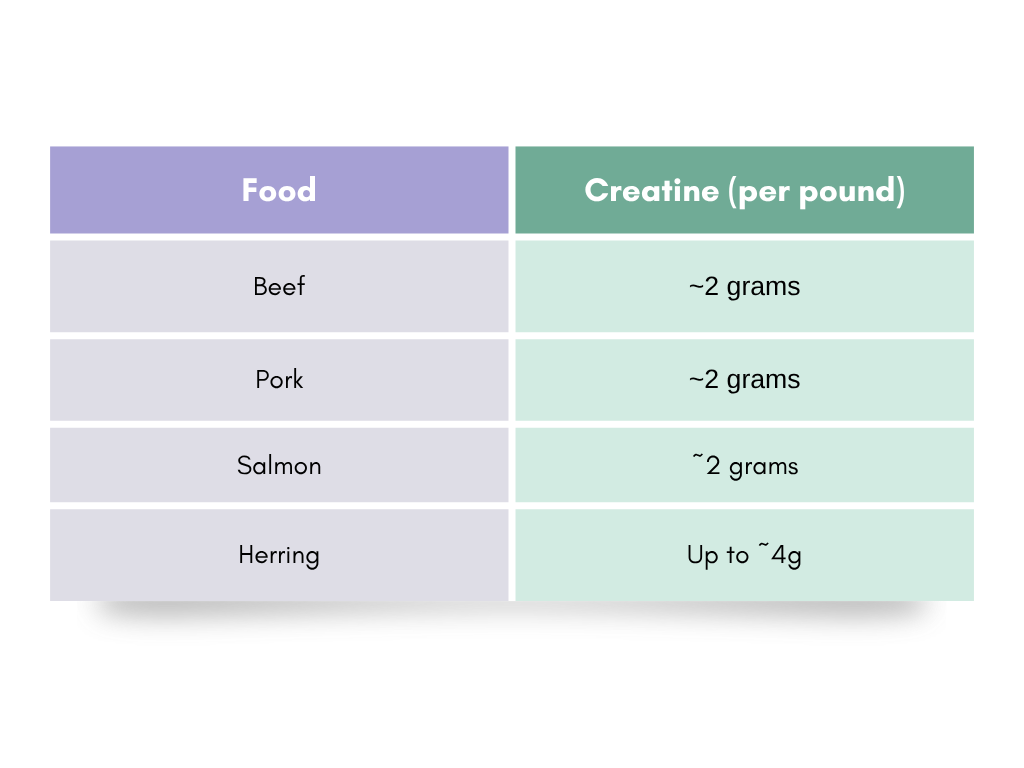
Cooking can reduce the creatine content of meat.
Because plant foods contain very little creatine, vegetarians and vegans generally have lower muscle creatine stores, making them more likely to experience noticeable benefits from supplementation.
What Does Creatine Supplementation Do?
Taking creatine increases the amount of creatine stored in your muscles.
With greater creatine stores, your body can:
Produce ATP more efficiently
Delay fatigue during high-intensity exercise
Improve recovery between repeated efforts
Support greater training volume over time
The biggest benefits don't come from taking creatine itself, they come from the fact that creatine allows you to train harder and recover better over time.
Who Can Benefit from Creatine?
Individuals Performing Resistance Training
This is where creatine has the strongest evidence.
When combined with resistance training, creatine consistently improves:
Strength
Power
Lean muscle mass
Training volume
Recovery between sets
If your goal is to build muscle, increase strength, or improve body composition, creatine monohydrate is one of the most effective supplements available.
Recreational Exercisers
You don't have to be a competitive athlete to benefit.
If you:
Lift weights a few times per week
Attend fitness classes
Perform functional training
Enjoy CrossFit or bootcamp workouts
Creatine may help you perform more work during your workouts, which can lead to greater improvements over time.
Endurance Athletes
Although creatine isn't an endurance supplement in the traditional sense, endurance athletes may still benefit.
Research suggests creatine may improve:
Sprint finishes
Hill climbing
Repeated high-intensity efforts
Recovery between intervals
Strength training sessions that support endurance performance
For marathon runners, cyclists, soccer players, hockey players, and tennis players, creatine can complement a well-rounded training program by improving the quality of strength and interval workouts.
Older Adults
One of the most exciting areas of creatine research is healthy aging.
As we age, we naturally lose muscle mass and strength, a process known as sarcopenia.
When paired with resistance training, creatine supplementation has been shown to help older adults:
Improve muscle strength
Increase lean body mass
Enhance physical function
Support independence with daily activities
Creatine isn't a replacement for exercise, but it may amplify the benefits of resistance training.
Women
Historically, much of the creatine research focused on men. More recent studies have shown that women may also benefit.
Emerging evidence suggests creatine may support:
Strength gains
Lean muscle maintenance
Recovery
Healthy aging
Bone-supportive exercise programs
Researchers are also exploring creatine's role during pregnancy, postpartum, and menopause, although more high-quality studies are still needed before routine recommendations can be made in these populations.
Vegetarians and Vegans
Since creatine is found primarily in animal products, people following vegetarian or vegan diets generally begin with lower creatine stores.
As a result, supplementation often leads to greater improvements in muscle creatine levels compared with individuals who regularly eat meat.
Beyond Muscle: Are There Other Benefits?
Researchers continue to investigate creatine's effects outside of exercise performance.
Areas of ongoing research include:
Brain health
Cognitive performance during sleep deprivation
Healthy aging
Neurological conditions
Recovery after injury
While some early findings are promising, the evidence is still evolving. At this time, creatine should primarily be viewed as a supplement for improving exercise performance, supporting muscle health, and enhancing training adaptations, not as a treatment for neurological or cognitive conditions.
Does Creatine Cause Weight Gain?
One of the biggest misconceptions about creatine is that it causes unhealthy weight gain.
In reality, creatine increases water stored inside muscle cells, not under the skin or as body fat.
This intracellular water is actually thought to support muscle function and may contribute to an environment that promotes muscle growth over time.
Some people notice a small increase in body weight during the first few weeks of supplementation due to increased muscle water content. This is normal and should not be confused with gaining body fat.
How Much Creatine Should You Take?
For most healthy adults, the recommended dose is simple:
Maintenance Dose
3–5 grams of creatine monohydrate per day
This amount is sufficient to fully saturate muscle creatine stores over time and is the dose used in the majority of research studies.
Larger individuals or those with greater muscle mass may benefit from doses closer to 5 grams daily, while smaller individuals often respond well to 3 grams daily.
The key to success is consistency. Taking creatine every day is more important than taking it at a specific time.
Should You "Load" Creatine?
You may have heard of a loading phase, which involves taking:
20 grams per day, divided into four 5-gram doses, for 5–7 days
Followed by 3–5 grams daily for maintenance
Loading helps saturate muscle creatine stores more quickly, allowing you to experience the benefits sooner.
However, loading is not necessary.
If you prefer to avoid taking larger doses, simply taking 3–5 grams daily will produce the same results, it just takes about 3–4 weeks instead of one week to fully saturate your muscles.
Bottom line: Both approaches work. Choose the one you'll stick with.
When Should You Take Creatine?
One of the most common questions I hear is:
"Should I take creatine before or after my workout?"
The answer is encouraging: it probably doesn't matter much.
Current research suggests that taking creatine consistently each day is far more important than the exact timing.
Some studies suggest a slight advantage to taking creatine after resistance training, particularly when paired with a meal containing protein and carbohydrates. These nutrients may help support creatine uptake into muscle.
If remembering to take supplements is a challenge, simply tie creatine to an existing habit, such as adding it to your morning smoothie, yogurt, oatmeal, or post-workout protein shake.
The best time to take creatine is the time you'll remember to take it every day.
What Type of Creatine Is Best?
Walk down the supplement aisle and you'll find dozens of different forms of creatine claiming to be "better" than the original.
Examples include:
Creatine hydrochloride (HCl)
Buffered creatine
Liquid creatine
Creatine nitrate
Creatine ethyl ester
Creatine gummies
Creatine blends
Despite the marketing, creatine monohydrate remains the gold standard.
It is:
The most researched form of creatine
The least expensive
Highly effective
Well absorbed
Supported by decades of safety data
At this time, there is no convincing evidence that newer forms consistently outperform creatine monohydrate.
My recommendation: Save your money and choose a plain creatine monohydrate powder.
Is Creatine Safe?
One of the reasons creatine remains so popular is because it is also one of the most well-studied dietary supplements available.
Research consistently demonstrates that creatine supplementation is safe for healthy adolescents and adults when used at recommended doses.
Numerous studies have found no evidence that creatine damages the kidneys or liver in healthy individuals.
However, if you have pre-existing kidney disease, liver disease, or another significant medical condition, it's important to speak with your physician or registered dietitian before starting any supplement.
Common Creatine Myths
Myth #1: "Creatine damages your kidneys."
The evidence says: ❌ False (for healthy individuals).
Creatine supplementation may cause a small increase in blood creatinine, a normal breakdown product of creatine. This can sometimes be mistaken for decreased kidney function, but creatinine is only one marker of kidney health.
Current evidence has not shown creatine to impair kidney function in healthy adults when consumed at recommended doses.
Myth #2: "Creatine causes dehydration."
For years, athletes were warned that creatine increased the risk of dehydration.
Research has not supported this concern.
In fact, some studies suggest creatine may improve fluid balance within muscle cells. That said, staying adequately hydrated remains important for everyone, whether you take creatine or not.
Myth #3: "Creatine causes muscle cramps."
Again, research does not support this claim.
Large studies in athletes have found no increase in muscle cramping among creatine users compared to non-users.
Myth #4: "Creatine is a steroid."
Absolutely not.
Creatine is a naturally occurring compound found in your own body and in foods like meat and fish.
It works by helping your muscles rapidly regenerate energy, it has nothing in common with anabolic steroids.
Myth #5: "Creatine makes you bulky."
Creatine does not increase body fat.
Some people notice a small increase in body weight during the first few weeks because muscles store additional water. This water is inside the muscle cell, not under the skin.
Over time, any additional weight from increased muscle mass reflects the ability to train harder, not fat gain.
What About Hair Loss?
One concern that continues to circulate online is whether creatine causes hair loss.
This belief stems from a small study published nearly two decades ago that observed an increase in dihydrotestosterone (DHT) in a group of rugby players after creatine supplementation. However, the study did not measure hair loss, and the findings have not been consistently replicated.
To date, there is no strong clinical evidence that creatine causes hair loss or baldness.
If you have a strong family history of androgenic alopecia or are concerned about hair loss, it's reasonable to discuss your concerns with your healthcare provider, but current research does not support avoiding creatine solely for this reason.
How to Choose a High-Quality Creatine Supplement
Dietary supplements are not regulated as strictly as prescription medications, making third-party testing an important consideration.
Look for products that have been independently tested by organizations such as:
NSF Certified for Sport®
Informed Sport®
USP Verified (less common for creatine but an excellent quality indicator when available)
You may also see Creapure® on the label. Creapure is a high-purity form of creatine monohydrate manufactured in Germany with rigorous quality standards.
While not a certification itself, it is widely regarded as a high-quality ingredient.
Registered Dietitian Picks
When recommending supplements, I prioritize products that use creatine monohydrate and undergo reputable third-party testing.
Some trusted options include:
Thorne Creatine Monohydrate (NSF Certified for Sport®)
Klean Athlete Klean Creatine® (NSF Certified for Sport®)
Momentous Creatine (NSF Certified for Sport®)
NutraBio Creatine Monohydrate (Informed Choice®)
NOW Sports Creatine Monohydrate (Informed Sport® on select products)
Transparent Labs Creatine HMB (Informed Choice®)
Remember, the "best" creatine isn't necessarily the most expensive. A simple, third-party tested creatine monohydrate is all most people need.
Who Should Talk with Their Healthcare Provider First?
Creatine is appropriate for many healthy adults, but it's always wise to consult your healthcare team if you:
Have kidney disease or significantly reduced kidney function
Have chronic liver disease
Are pregnant or breastfeeding
Take medications that may affect kidney function
Have a complex medical history
Are unsure whether supplementation is appropriate for you
A registered dietitian can also help determine whether creatine fits your nutrition goals and training routine.
Key Takeaways
Creatine isn't just for bodybuilders, it's one of the most thoroughly researched and effective supplements available for supporting strength, power, muscle health, and exercise performance.
For most healthy adults:
Creatine monohydrate is the best choice.
3–5 grams per day is sufficient.
Loading is optional.
Timing matters far less than consistency.
Research continues to support its safety when used appropriately in healthy individuals.
Whether you're lifting weights, training for your next race, working to maintain muscle as you age, or simply looking to get more out of your workouts, creatine may be a worthwhile addition to your routine.
As with any supplement, remember that creatine works best as part of a strong foundation that includes regular exercise, adequate protein intake, quality sleep, and a balanced, nutrient-rich diet.
Frequently Asked Questions (Great for SEO)
Does creatine cause kidney damage?
Current research indicates creatine does not damage the kidneys in healthy individuals when taken at recommended doses. People with existing kidney disease should consult their healthcare provider before supplementation.
Is creatine only for bodybuilders?
No. Research suggests creatine may benefit recreational exercisers, endurance athletes, older adults, vegetarians, and women in addition to strength athletes.
What is the best type of creatine?
Creatine monohydrate remains the most researched, effective, and affordable form available.
How much creatine should I take?
Most healthy adults benefit from 3–5 grams daily. Loading is optional and primarily speeds muscle saturation.
Can women take creatine?
Yes. Research suggests women may benefit from creatine supplementation for strength, lean mass, recovery, and healthy aging, particularly when combined with resistance training.
References
Forbes, S. C., Candow, D. G., Ferreira, L. H. B., & colleagues. (2024). Creatine and cognition in aging: A systematic review of evidence in older adults. Nutrition Reviews, 84(2), 333–350.
Mayo Clinic. (2026). Creatine. https://www.mayoclinic.org/drugs-supplements-creatine/art-20347591
Sharifian, G., Candow, D. G., Forbes, S. C., et al. (2025). Impact of creatine supplementation in older adults: A systematic review and meta-analysis. European Review of Aging and Physical Activity.
Stout, J. R., Candow, D. G., Forbes, S. C., et al. (2026). Creatine monohydrate for lean mass, strength, and bone density in postmenopausal women: A systematic review and meta-analysis. Journal of Dietary Supplements.
Walters, J., et al. (2025). Does creatine supplementation enhance performance in active females? A systematic review. Nutrients, 17(2), 238.
Kreider, R. B., Kalman, D. S., Antonio, J., et al. (2017). International Society of Sports Nutrition position stand: Safety and efficacy of creatine supplementation in exercise, sport, and medicine. Journal of the International Society of Sports Nutrition, 14, 18. (Seminal position stand still considered the foundational reference.)
