Hydration Explained: How Much Water Do You Really Need?
Hydration is one of the most commonly discussed topics in health and wellness, yet it is also one of the most misunderstood. Many people have heard the recommendation to drink "eight glasses of water per day" or aim for 64 ounces daily, but where did that advice come from? Is it accurate? And do beverages like coffee, tea, sparkling water, and even foods like soup or gelatin count toward hydration?
Let’s explore what hydration actually means, how to estimate your fluid needs, how hydration requirements change throughout life, and what the latest research tells us about maintaining proper hydration.
Why Hydration Matters
Water is essential for nearly every physiological process in the body. Approximately 50–70% of the human body is composed of water, with the exact amount varying based on age, sex, body composition, and activity level.
Water plays critical roles in:
Regulating body temperature
Transporting nutrients and oxygen
Removing metabolic waste
Supporting digestion
Lubricating joints
Maintaining blood volume
Supporting cognitive function
Facilitating exercise performance
Even mild dehydration can negatively impact physical performance, mood, concentration, and cognitive function.
Where Did the "64 Ounces Per Day" Recommendation Come From?
The commonly cited recommendation to drink eight 8-ounce glasses of water per day (64 ounces total) likely originated from a misinterpretation of guidance issued by the U.S. Food and Nutrition Board in 1945.
At the time, the Board suggested that adults consume approximately 2.5 liters (about 84 ounces) of water daily. However, an important detail is often overlooked: the recommendation referred to total water intake from all sources, including both beverages and food.
Many foods, particularly fruits, vegetables, soups, yogurt, and other high-moisture foods, contribute significantly to daily hydration. Over time, the original guidance was simplified into the message, "drink eight glasses of water a day," despite little scientific evidence supporting a one-size-fits-all fluid goal.
Today, experts recognize that hydration needs vary widely based on factors such as age, body size, activity level, climate, health status, and dietary habits. Rather than aiming for a universal 64-ounce target, hydration recommendations are increasingly individualized to meet each person's unique needs.
How Much Water Do You Actually Need?
There is no single hydration recommendation that fits everyone.
The National Academies of Sciences, Engineering, and Medicine provide Adequate Intake (AI) recommendations for total water intake from all beverages and foods:
Daily Fluid Recommendations
Total Water Intake Recommendations per The National Academies of Sciences, Engineering, and Medicine:
Adult Men~3.7 liters (125 oz)
Adult Women~2.7 liters (91 oz)
Pregnant Women~3.0 liters (101 oz)
Breastfeeding Women~3.8 liters (128 oz)
These values include water obtained from:
Plain water
Coffee
Tea
Milk
Sparkling water
Juice
Foods containing water
Approximately 20–30% of daily water intake typically comes from food.
A Practical Method for Estimating Fluid Needs
A commonly used estimate for healthy adults is:
30–35 mL per kilogram of body weight per day
(Learn how to convert pounds to kilograms, milliliters to ounces in the blog: Calculating Macros for Weight Loss and Muscle Gain - https://www.schmidt-nutritionandwellness.com/blog-1/calculating-macros-for-weight-loss-and-muscle-gain)
For example:
A 180-pound individual (82 kg):
82 × 30 = 2,460 mL
82 × 35 = 2,870 mL
Estimated need:
2.5–2.9 liters daily (85–98 ounces)
This estimate should be adjusted upward for:
Exercise
Hot climates
High humidity
Pregnancy
Breastfeeding
Certain medical conditions
High altitude environments
How Does the Body Lose Water?
Water losses occur continuously throughout the day.
Urine
The kidneys regulate fluid balance and account for the largest daily water losses.
Sweat
Sweat production varies dramatically based on:
Exercise intensity
Environmental temperature
Humidity
Clothing
Individual sweat rates
Athletes may lose more than 1–2 liters of fluid per hour during strenuous activity.
Respiration
Every breath releases water vapor.
Respiratory fluid losses increase during:
Exercise
Dry climates
High altitude exposure
Feces
A smaller amount of water is lost through normal bowel movements.
Insensible Losses
Water is continuously lost through the skin, even when not visibly sweating.
What Actually Counts Toward Hydration?
One of the biggest hydration myths is that only plain water counts.
In reality, most fluids and many foods contribute to hydration.
Beverages That Count
✔ Water
✔ Sparkling water
✔ Tea
✔ Coffee
✔ Milk
✔ Sports drinks
✔ Electrolyte beverages
✔ Juice
Foods That Contribute to Hydration
Many foods contain substantial amounts of water:
Watermelon (~92% water)
Strawberries (~91% water)
Cucumbers (~95% water)
Lettuce (~96% water)
Tomatoes (~94% water)
Soups and broths
Yogurt
Gelatin (Jell-O)
For many individuals, foods contribute approximately 20–30% of daily hydration needs.
Does Coffee and Tea Dehydrate You?
This is another common myth.
Research consistently demonstrates that moderate caffeine intake does not cause net dehydration in habitual caffeine consumers.
While caffeine can have a mild diuretic effect, the fluid consumed in coffee and tea generally exceeds any additional fluid losses.
Current evidence suggests:
Coffee contributes to hydration.
Tea contributes to hydration.
Moderate caffeine intake does not appear to impair hydration status in healthy adults.
For most people, coffee and tea absolutely count toward daily fluid intake.
How Thirst Changes as We Age
One important challenge with aging is that thirst becomes a less reliable indicator of hydration status.
Research shows that older adults often experience:
Reduced thirst sensation
Decreased kidney concentrating ability
Lower total body water stores
Greater susceptibility to dehydration
As a result, older adults may not feel thirsty until dehydration is already developing.
This helps explain why dehydration-related hospitalizations occur more frequently among older populations.
Hydration Tips for Older Adults
Drink fluids regularly throughout the day. Small frequent sips!
Avoid relying solely on thirst.
Keep water readily accessible.
Include hydrating foods at meals.
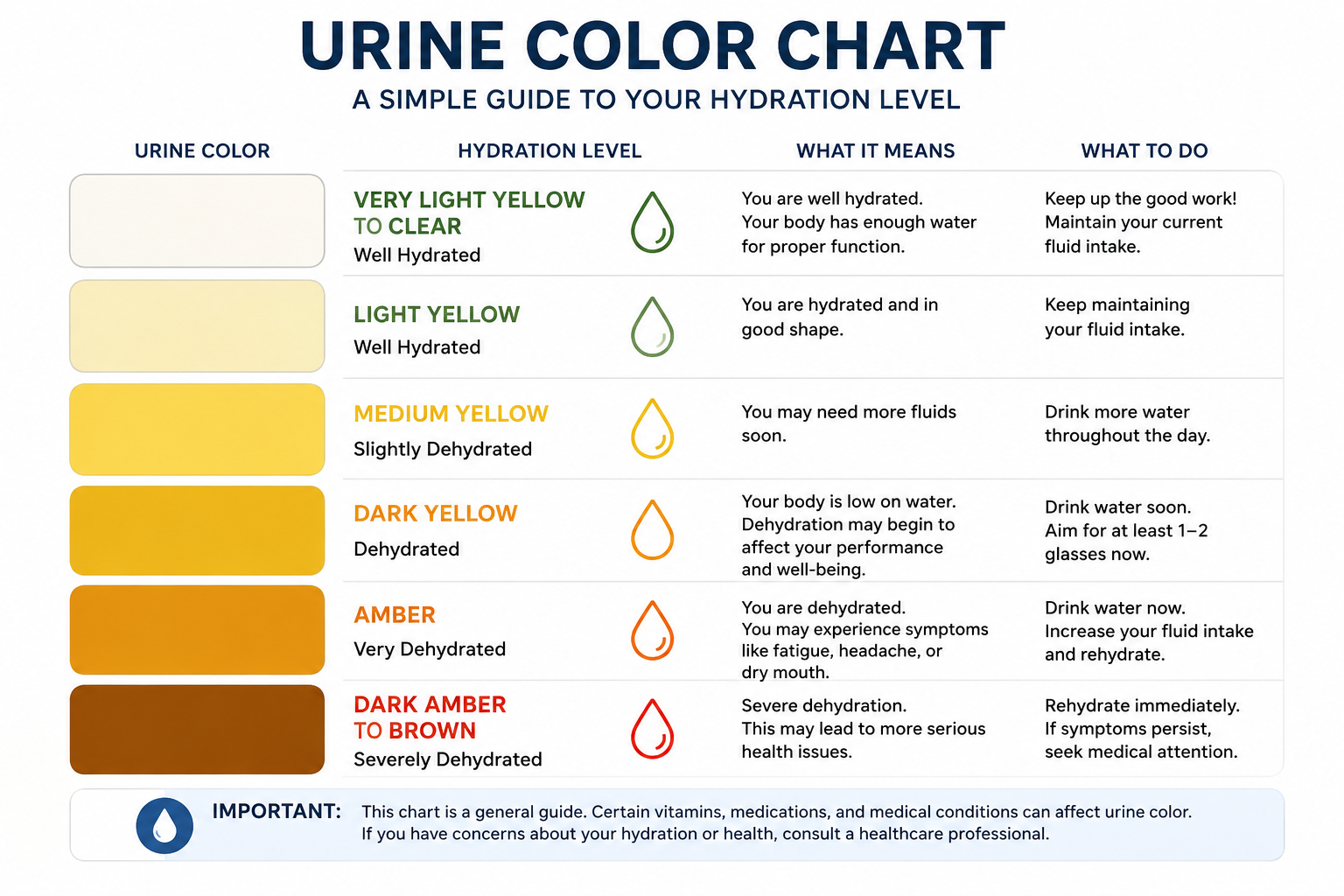
Monitor urine color.
How Exercise Increases Hydration Needs
Physical activity significantly increases fluid requirements.
Sweat losses can vary from less than 0.5 liters per hour to over 2 liters per hour depending on:
Body size
Fitness level
Environment
Exercise intensity
Even modest dehydration can negatively impact:
Endurance performance
Strength output
Cognitive performance
Recovery
Thermoregulation
How to Estimate Sweat Loss During Exercise
One of the most practical methods is a simple pre- and post-workout weigh-in.
Step 1
Weigh yourself before exercise.
Step 2
Complete your workout.
Step 3
Towel off and weigh yourself again.
Step 4
Calculate weight lost.
Every pound lost represents approximately:
16–24 ounces (475–710 mL) of fluid loss
Example:
Pre-workout: 180 lb
Post-workout: 178 lb
Fluid loss:
2 pounds
Estimated replacement need:
32–48 ounces of fluid
This method can help athletes develop individualized hydration strategies.
Signs You May Need More Fluids
Potential signs of dehydration include:
Dark yellow urine
Dry mouth
Headaches
Dizziness
Fatigue
Reduced exercise performance
Increased heart rate during exercise
Difficulty concentrating
However, urine color alone is not a perfect indicator and may be influenced by supplements, medications, and dietary factors.
Do You Need Electrolytes?
Electrolytes become increasingly important when:
Exercising longer than 60–90 minutes
Exercising in hot conditions
Experiencing heavy sweat losses
Performing multiple workouts per day
Key electrolytes include:
Sodium
Potassium
Magnesium
Chloride
For shorter workouts, water is often sufficient.
For prolonged exercise, electrolyte replacement may improve fluid retention and performance.
Practical Hydration Recommendations
Rather than obsessing over a universal water target, focus on overall hydration habits.
Aim to:
Drink fluids consistently throughout the day.
Include water-rich foods.
Increase intake during exercise and hot weather.
Monitor urine color as one tool.
Pay attention to thirst, especially if you are younger and healthy.
Be proactive with hydration as you age.
Hydration needs are highly individualized. The best hydration strategy is one that accounts for your body size, activity level, climate, age, and personal sweat losses.
Key Takeaways
The "64 ounces per day" recommendation is not strongly supported by modern evidence.
Fluid needs vary based on body size, activity level, environment, and age.
Coffee, tea, sparkling water, soup, fruits, vegetables, and gelatin all contribute to hydration.
Older adults often experience reduced thirst sensation and may be at greater risk for dehydration.
Exercise can substantially increase hydration requirements.
Monitoring body weight changes around workouts can help estimate sweat losses.
Consistent hydration supports physical performance, cognitive function, health, and recovery.
Proper hydration is less about chasing a magic number and more about consistently meeting your body's changing needs.
References
Institute of Medicine. (2005). Dietary reference intakes for water, potassium, sodium, chloride, and sulfate. National Academies Press. https://doi.org/10.17226/10925
Kenney, W. L., Chiu, P., & Costill, D. L. (2020). Physiology of sport and exercise (7th ed.). Human Kinetics.
Maughan, R. J., Watson, P., Cordery, P. A., Walsh, N. P., Oliver, S. J., Dolci, A., Rodriguez-Sanchez, N., Galloway, S. D. R., & Shirreffs, S. M. (2016). A randomized trial to assess the potential of different beverages to affect hydration status: Development of a beverage hydration index. American Journal of Clinical Nutrition, 103(3), 717–723. https://doi.org/10.3945/ajcn.115.114769
Popkin, B. M., D’Anci, K. E., & Rosenberg, I. H. (2010). Water, hydration, and health. Nutrition Reviews, 68(8), 439–458. https://doi.org/10.1111/j.1753-4887.2010.00304.x
Sawka, M. N., Burke, L. M., Eichner, E. R., Maughan, R. J., Montain, S. J., & Stachenfeld, N. S. (2007). American College of Sports Medicine position stand: Exercise and fluid replacement. Medicine & Science in Sports & Exercise, 39(2), 377–390. https://doi.org/10.1249/mss.0b013e31802ca597
Stookey, J. D. (2005). High prevalence of plasma hypertonicity among community-dwelling older adults: Results from NHANES III. Journal of the American Dietetic Association, 105(8), 1231–1239. https://doi.org/10.1016/j.jada.2005.05.003
U.S. National Academies of Sciences, Engineering, and Medicine. (2020). Dietary reference intakes for water. National Academies Press.
Volterman, K. A., Obeid, J., & Timmons, B. W. (2019). Effect of hydration status on cognitive performance in children. Nutrients, 11(11), 2672. https://doi.org/10.3390/nu11112672
World Health Organization. (2023). Healthy hydration and water intake guidance. https://www.who.int
