Halloween Candy Without the Guilt: What Intuitive Eating Research Says
Halloween comes with costumes, pumpkins, parties and, of course, candy.
For many people, though, Halloween candy comes with something else: guilt.
Maybe you've caught yourself thinking:
“I was so bad today.”
“I need to work this off tomorrow.”
“I shouldn't have eaten that.”
“I'll start eating healthy again on Monday.”
It is easy for food to become wrapped up in rules and morality, particularly around holidays. But eating a Reese's Peanut Butter Cup or a handful of candy corn doesn't make you “bad,” just as eating a salad doesn't make you “good.”
Food is food and nutrition is much bigger than a single snack, meal, or holiday.
One approach that can help people develop a more peaceful relationship with food is intuitive eating. Rather than relying exclusively on external food rules, intuitive eating encourages awareness of hunger, fullness, satisfaction, health, and how different foods make your body feel.
And importantly, intuitive eating doesn't mean throwing nutrition out the window.
Let's look at what the research actually tells us.
What Is Intuitive Eating?
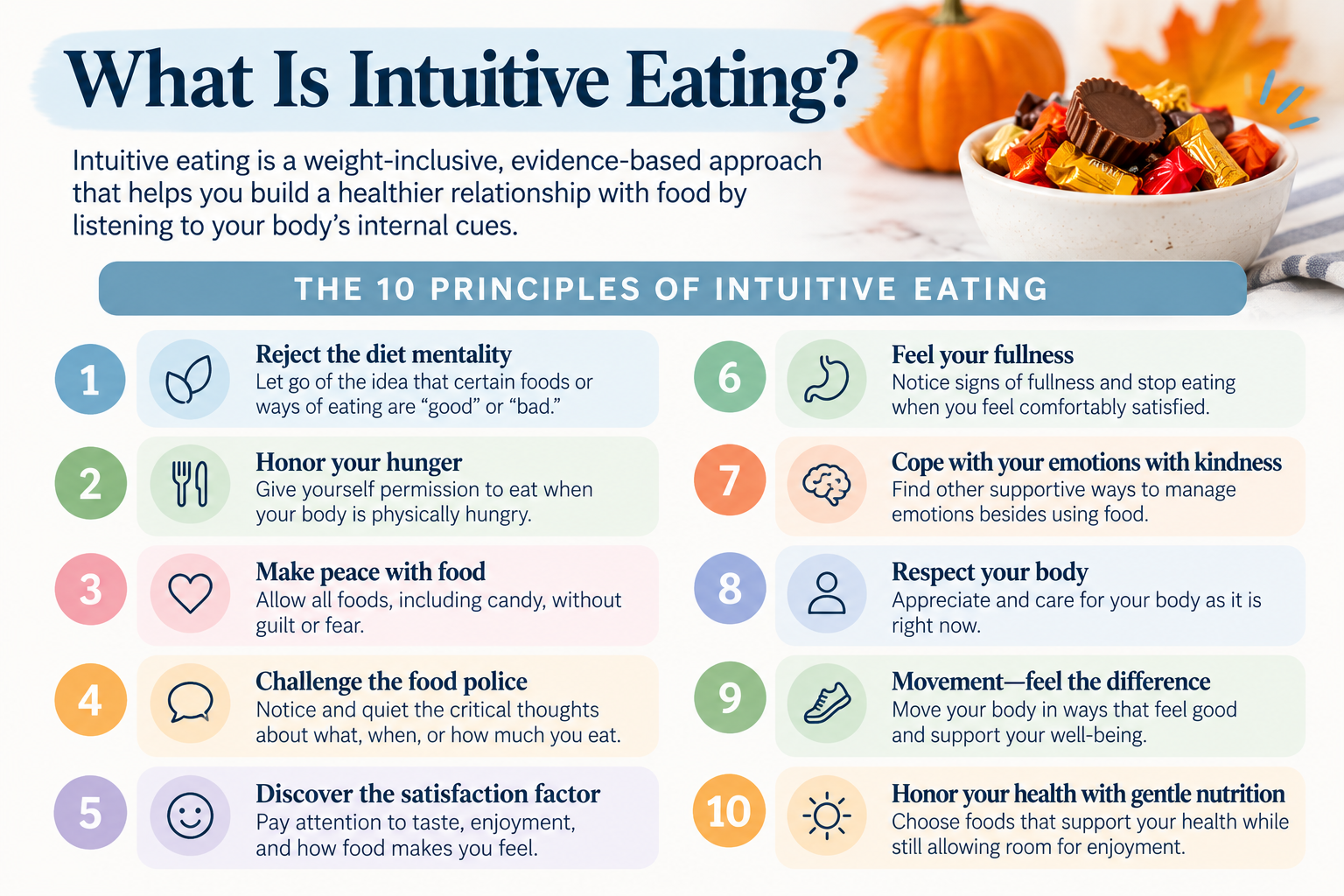
Intuitive eating is a weight-inclusive approach to eating originally developed by registered dietitians Evelyn Tribole and Elyse Resch.
At its core, intuitive eating encourages people to move away from rigid diet rules and become more aware of their body's internal signals.
The framework includes 10 principles:
Reject the diet mentality
Honor your hunger
Make peace with food
Challenge the food police
Discover the satisfaction factor
Feel your fullness
Cope with your emotions with kindness
Respect your body
Movement, feel the difference
Honor your health with gentle nutrition
One of the most misunderstood parts of intuitive eating is unconditional permission to eat.
Giving yourself permission to eat candy doesn't mean you have to eat every piece of candy in the house. Instead, it means removing the idea that candy is a forbidden food that you must eat now because you won't be “allowed” to have it again tomorrow.
What Does the Research Say About Intuitive Eating?
Intuitive eating has become increasingly studied over the past several decades, and the research is promising, particularly when we look at eating behaviors and psychological well-being.
A 2021 meta-analysis including 97 studies examined relationships between intuitive eating and 23 psychological outcomes. Higher intuitive eating was associated with more positive body image and psychological well-being and lower levels of eating and body-image disturbances.
However, there is an important caveat: approximately 89% of the included studies were cross-sectional. That means we can identify relationships, but we cannot automatically conclude that intuitive eating caused those outcomes.
Intervention research adds another piece of the puzzle.
A systematic review and meta-analysis of intuitive-eating interventions found that interventions produced significant improvements in intuitive eating, with a large pooled effect. Researchers also observed improvements across several other health-related outcomes.
This suggests that intuitive eating skills can be taught and strengthened, not simply something you're either naturally good or bad at.
Does Intuitive Eating Mean Nutrition Doesn't Matter?
Absolutely not.
This is one of the biggest misconceptions about intuitive eating.
Intuitive eating isn't:
“Eat whatever you want whenever you want without thinking about nutrition.”
It is closer to:
“Learn to incorporate nutrition without allowing nutrition rules to completely control your relationship with food.”
A 2022 systematic review examined 14 intuitive-eating intervention studies representing nearly 4,000 participants. All of the included studies reported either a positive or neutral effect on diet quality following intuitive-eating interventions.
Researchers also observed favorable changes in eating behaviors.
In other words, moving away from rigid dieting doesn't necessarily mean nutritional quality deteriorates.
At the same time, the evidence isn't completely settled. Another systematic review of randomized trials examining mindful and intuitive eating found limited evidence that these interventions substantially changed energy intake or diet quality, and the researchers noted limitations in the quality of the available studies.
That's important.
Good nutrition science isn't about cherry-picking studies that support the message we want to hear. The current evidence suggests intuitive eating may be particularly useful for improving people's relationship with food and eating behaviors, while more high-quality research is needed to determine its effects on specific dietary and physical-health outcomes.
So What Does This Have to Do With Halloween Candy?
Quite a bit.
Consider what happens when you tell yourself:
“After Halloween, I'm not eating any more candy.”
Suddenly, that bowl of candy sitting on the counter may feel much more important.
You might think:
I better have some tonight because tomorrow I'm being good again.
That can create a familiar cycle:
Restriction → craving/preoccupation → overeating → guilt → restriction
Although intuitive-eating research doesn't prove that everyone who restricts candy will overeat it, experimental and observational research, particularly in children, suggests that restriction can affect how desirable or interesting a restricted food becomes.
Studies examining restrictive feeding practices have found associations between restriction and children's eating behaviors, while experimental research involving chocolate has found that restriction can increase children's relative preoccupation with the restricted food.
That doesn't mean children, or adults, need unlimited access to candy at all times.
It means how we talk about and manage highly palatable food matters.
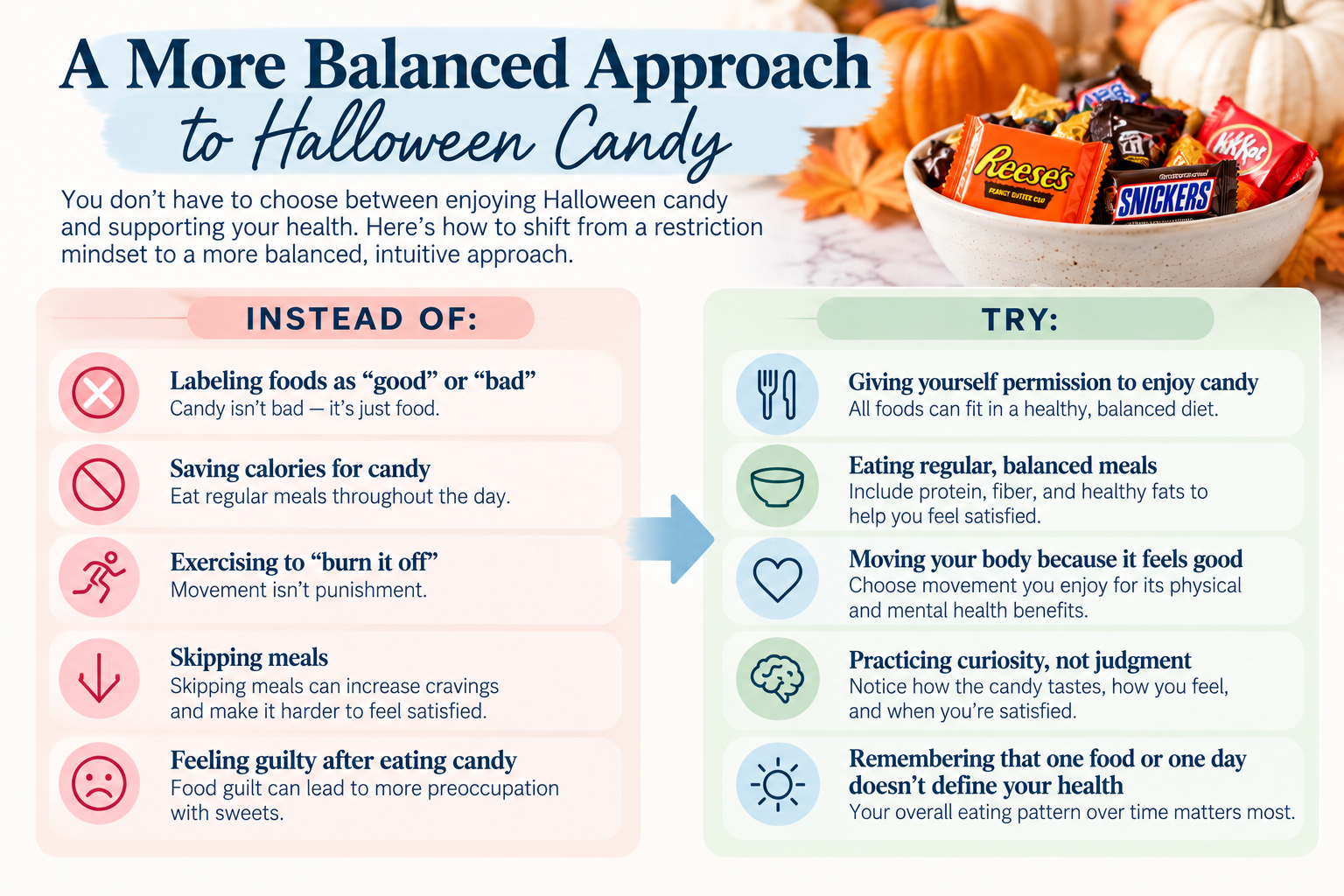
Candy Doesn't Need to Be “Earned”
Another common Halloween pattern is trying to compensate for candy.
You might hear:
“I'll go for an extra-long run tomorrow to burn this off.”
Movement has tremendous benefits for physical and mental health. But exercise doesn't need to be punishment for eating.
You don't have to earn a Snickers bar by running three miles.
You also don't need to skip breakfast because you ate candy the night before.
Instead, return to your normal routine.
Eat breakfast.
Eat lunch.
Eat dinner.
Include protein, carbohydrates, fats, fruits, vegetables, and fiber throughout your day.
Drink water.
Move your body in ways that feel good.
And yes, you can still have some Halloween candy.
One night of eating differently than usual does not erase your usual nutrition habits.
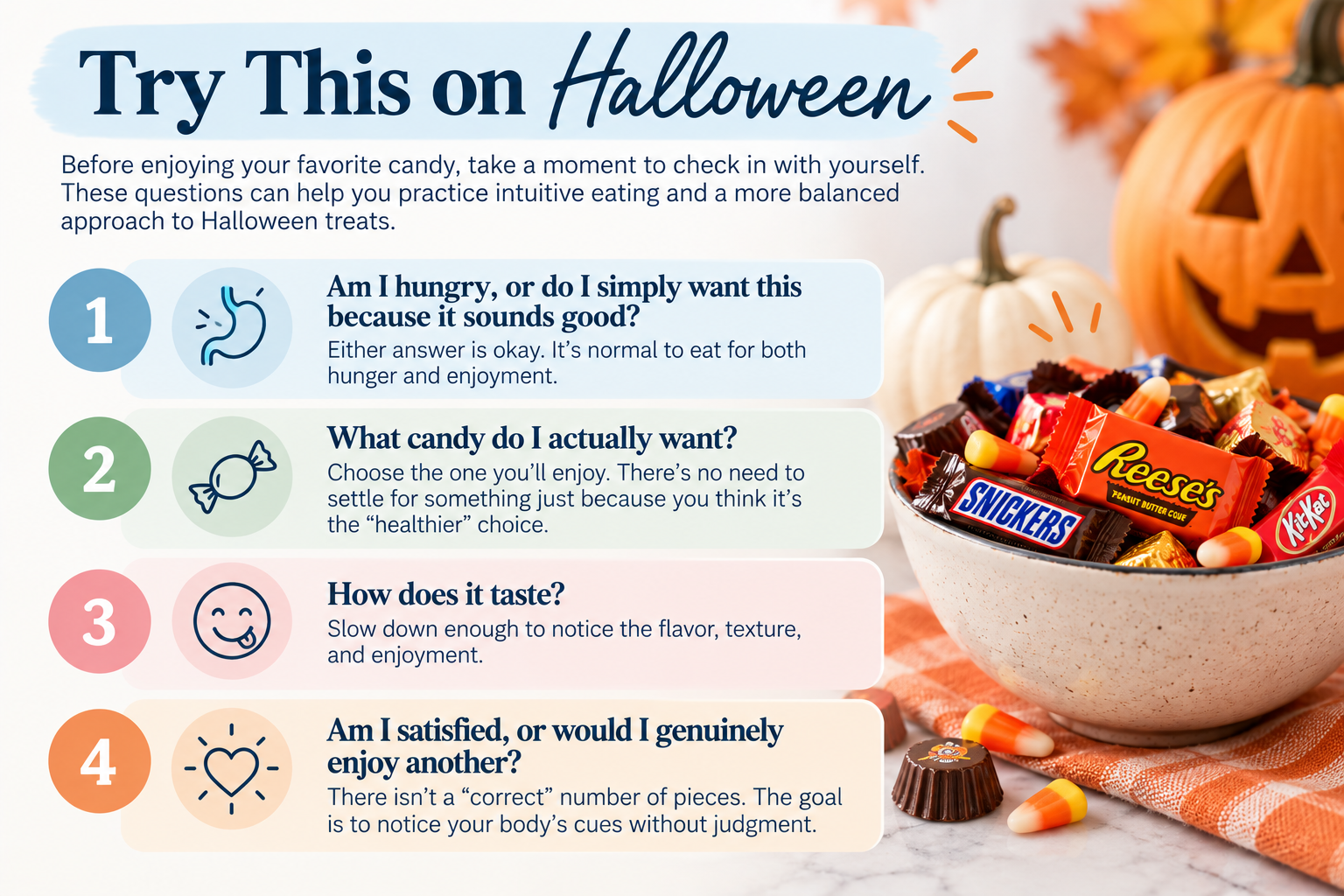
Try Asking “Do I Actually Want This?”
Intuitive eating isn't simply about giving yourself permission to eat. It's also about paying attention.
Imagine you've eaten three pieces of Halloween candy.
Instead of immediately reaching for another or telling yourself you're absolutely not allowed another, pause and check in.
Ask yourself:
Do I actually want another piece?
Maybe the answer is yes.
Great. Enjoy it.
Maybe you realize the first few pieces tasted fantastic, but now you're mostly eating them because they're sitting in front of you.
That's useful information too.
The goal isn't to find the “correct” number of pieces.
It's learning to notice hunger, fullness, satisfaction, taste, and how your body feels without allowing guilt to make the decision for you.
Choose the Candy You Actually Like
Halloween can also be a great opportunity to practice the satisfaction factor.
Instead of choosing something simply because you think it's the “healthier” option, consider what you actually enjoy.
If you really want chocolate, eating something else in an attempt to avoid chocolate may leave you unsatisfied—and you may end up eating the chocolate afterward anyway.
Give yourself permission to choose something you genuinely enjoy.
Then slow down enough to actually taste it.
Is it as good as you expected?
Would you like another?
Are you satisfied?
You might be surprised how differently food feels when you know you can have it again.
Pair Candy With Nutrition When It Makes Sense
Removing guilt from candy doesn't mean forgetting everything you know about nutrition.
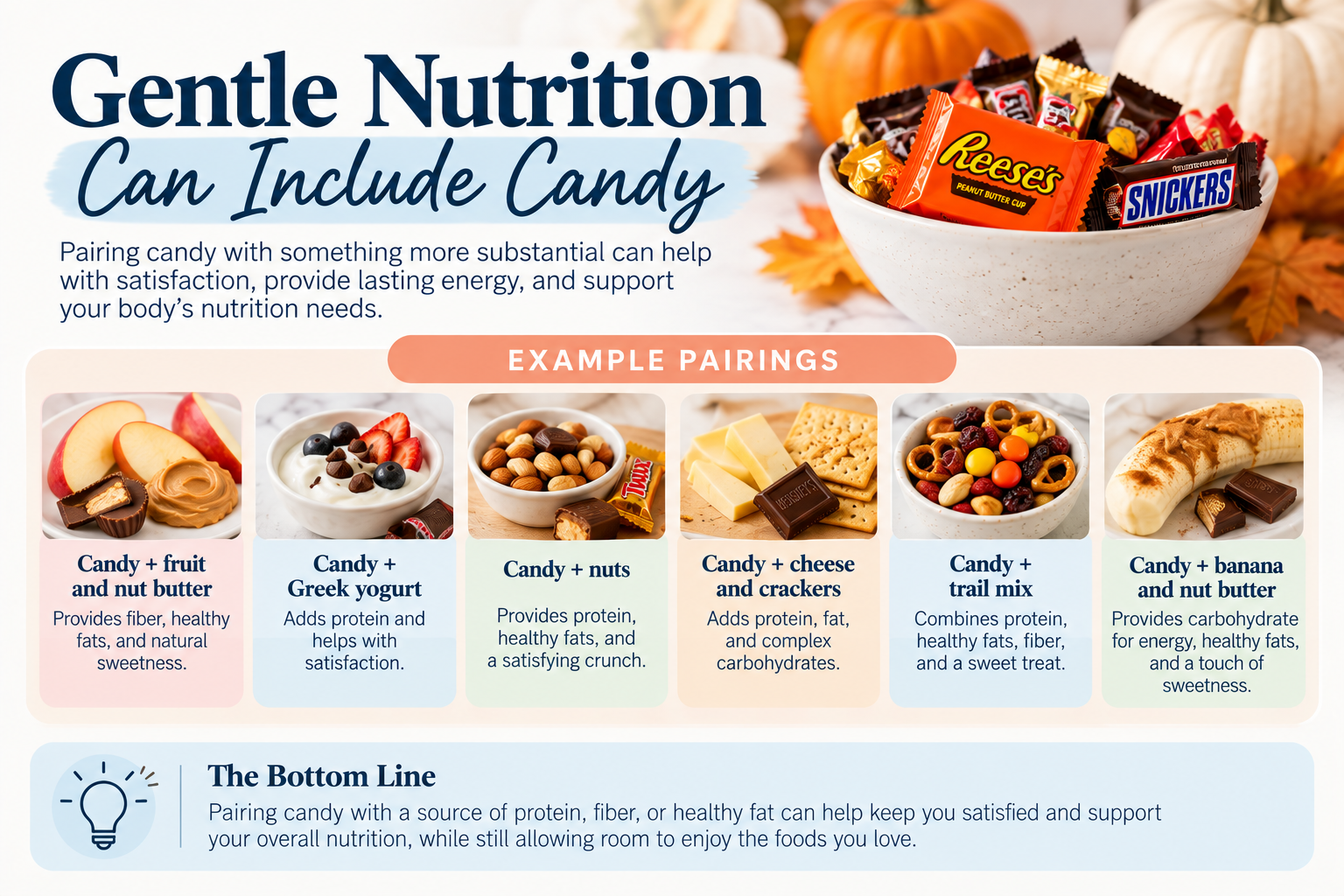
This is where the intuitive-eating principle of gentle nutrition becomes especially useful.
For example, if you're hungry in the afternoon and want some Halloween candy, candy alone may not keep you satisfied for very long.
You could pair it with something containing protein, fiber, or fat:
Chocolate + Greek yogurt
Candy + nuts
Peanut butter cup + apple
Chocolate + cheese and crackers
Candy after a balanced meal
The purpose isn't to “cancel out” the sugar.
It is simply recognizing that sometimes you want candy and your body needs something more substantial.
Both things can be true.
What About Kids and Halloween Candy?
Halloween can also shape the messages children receive about food.
Parents understandably want their children to eat nutritious foods and avoid eating enormous quantities of candy. But extremely restrictive approaches may have unintended consequences.
Systematic reviews and meta-analyses examining parental restrictive feeding practices have found relationships between certain forms of restriction and children's eating behaviors. Experimental studies have also demonstrated that restricting particular foods can increase children's interest or preoccupation with those foods.
Again, this doesn't mean parents can't provide structure.
Parents can decide when and where food is offered, while giving children opportunities to practice listening to hunger, fullness, and satisfaction.
Instead of:
“You've already had two pieces. That's enough sugar.”
Consider conversations such as:
“Which candy was your favorite?”
“How does your tummy feel?”
“Do you want to save some for tomorrow?”
The goal is to help children gradually develop eating skills, not make candy feel like a rare, forbidden treasure.
What If You Eat More Candy Than Feels Comfortable?
It happens.
Maybe you eat past fullness.
Maybe you have more candy than you intended.
Maybe you wake up November 1 feeling like you “messed up.”
You don't need to fix it.
You don't need to skip breakfast.
You don't need to cut out carbohydrates.
You don't need an extra workout.
And you don't need a detox.
Instead, get curious.
Was I physically hungry?
Was I restricting candy beforehand?
Was I distracted while eating?
Was I stressed, tired, bored, or emotional?
Did I actually enjoy what I ate?
What would help me feel good now?
Curiosity gives you information.
Guilt usually doesn't.
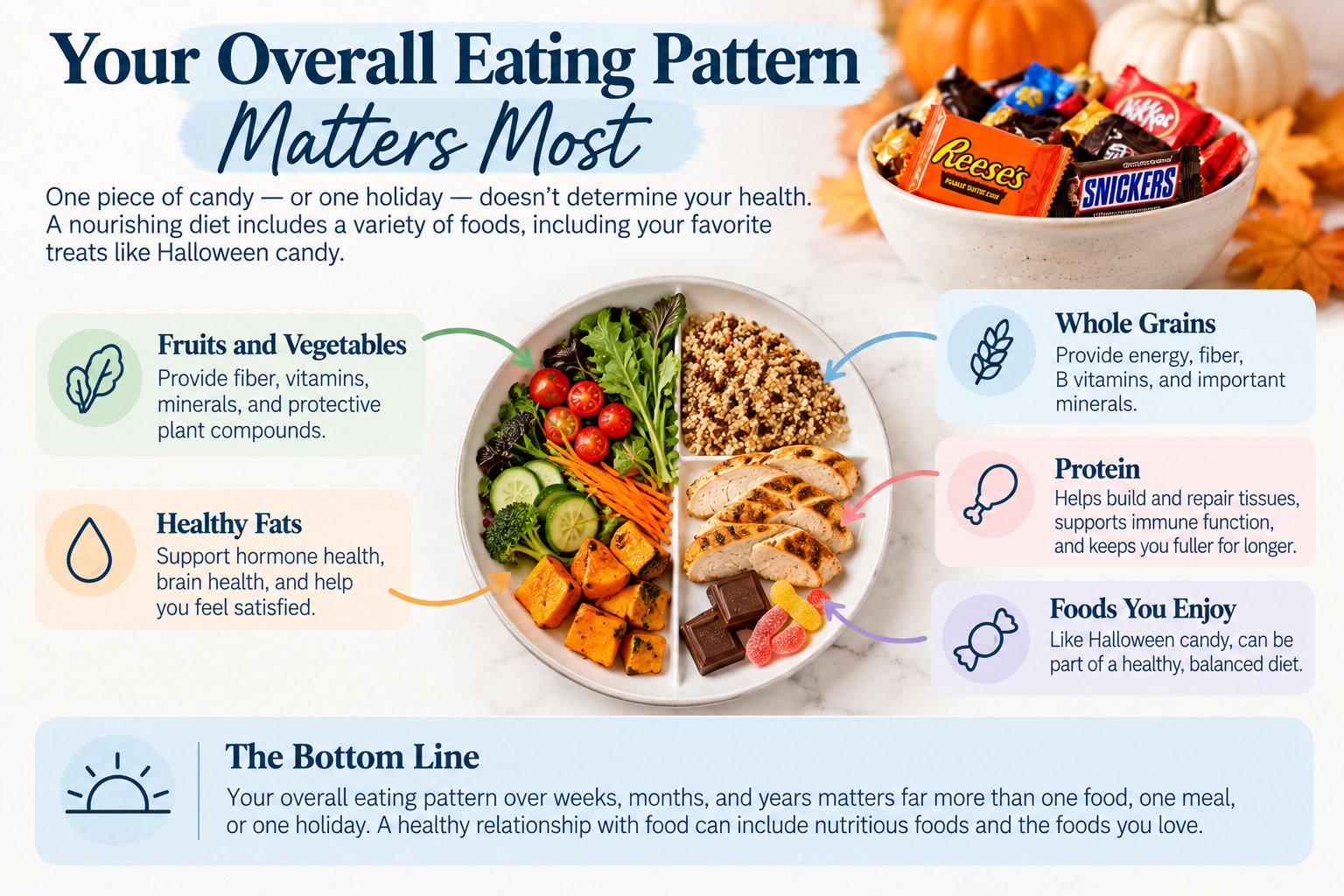
Zoom Out: Your Overall Eating Pattern Matters
Nutrition isn't determined by one piece of candy, or one evening.
Your overall dietary pattern across weeks, months, and years matters far more than whether you ate Halloween candy on October 31.
A nourishing diet can include vegetables, fruit, whole grains, protein, healthy fats and foods eaten simply because they taste good.
Those things don't have to compete with each other.
This is one of the concepts behind gentle nutrition: health matters, but food choices don't have to be perfect to support health.
This Halloween, Try Something Different
Instead of approaching Halloween thinking:
“How can I avoid eating candy?”
Try asking:
“How can I enjoy Halloween candy in a way that feels satisfying and good in my body?”
Give yourself permission to eat the candy you actually enjoy.
Eat regular meals throughout the day rather than “saving calories” for later.
Pay attention to hunger and fullness.
Notice when the candy stops tasting as satisfying.
And if you eat more than you intended?
Move on.
No compensation.
No punishment.
No Monday restart.
No guilt required.
The Bottom Line
Intuitive eating isn't about eating perfectly and it isn't about ignoring nutrition.
It's about learning to make food choices using internal cues, satisfaction, your health needs, and gentle nutrition rather than fear, guilt, and rigid rules.
Research suggests that intuitive eating is associated with healthier psychological outcomes and fewer eating- and body-image disturbances, while intervention studies show that intuitive-eating skills can improve with practice. Research also suggests that intuitive-eating interventions do not inherently worsen diet quality, although stronger randomized trials are still needed to understand their effects on dietary intake and long-term physical health.
So this Halloween, have the Reese's.
Have the Snickers.
Have the candy corn, if you're one of the people who actually likes candy corn.
Enjoy it.
Pay attention to how it tastes and how your body feels.
Then carry on with your day.
Because a healthy relationship with food has room for both nutrition and Halloween candy.
References
Babbott, K. M., Cavadino, A., Brenton-Peters, J., Consedine, N. S., & Roberts, M. (2023). Outcomes of intuitive eating interventions: A systematic review and meta-analysis. Eating Disorders, 31(1), 33–63. https://doi.org/10.1080/10640266.2022.2030124
Grider, H. S., Douglas, S. M., & Raynor, H. A. (2021). The influence of mindful eating and/or intuitive eating approaches on dietary intake: A systematic review. Journal of the Academy of Nutrition and Dietetics, 121(4), 709–727.e1. https://doi.org/10.1016/j.jand.2020.10.019
Hensley-Hackett, K., Bosker, J., Keefe, A., Reidlinger, D., Warner, M., D'Arcy, A., & Utter, J. (2022). Intuitive eating intervention and diet quality in adults: A systematic literature review. Journal of Nutrition Education and Behavior, 54(12), 1099–1115. https://doi.org/10.1016/j.jneb.2022.08.008
Linardon, J. (2021). Intuitive eating and its psychological correlates: A meta-analysis. International Journal of Eating Disorders, 54(7), 1073–1098. https://doi.org/10.1002/eat.23509
Say, A., de la Piedad Garcia, X., & Mallan, K. M. (2023). The correlation between different operationalisations of parental restrictive feeding practices and children's eating behaviours: Systematic review and meta-analyses. Appetite, 180, 106320. https://doi.org/10.1016/j.appet.2022.106320
Say, A., de la Piedad Garcia, X., & Mallan, K. M. (2024). Associations between restrictive feeding practices and children's dietary intake: Systematic review and meta-analyses. Appetite. https://doi.org/10.1016/j.appet.2024.107508
