Enjoy the Candy, Skip the Overeating: A Dietitian’s Guide to Halloween
Halloween can be a surprisingly stressful holiday when you’re trying to improve your nutrition.
Suddenly, candy is everywhere. It’s sitting in the office break room, displayed at the grocery store, tucked into your kids’ trick-or-treat bags, and probably sitting in a bowl somewhere in your house.
If you’re working toward a health or weight-management goal, your first instinct might be:
“I just won’t eat any.”
But enjoying a few pieces of Halloween candy doesn’t mean you’ve ruined your nutrition goals and trying to exercise perfect control around food isn't necessarily the best strategy either.
Instead of approaching Halloween with an all-or-nothing mentality, we can use strategies from mindful and intuitive eating to enjoy candy intentionally while still supporting our health.
Why Is It So Easy to Overeat Halloween Candy?
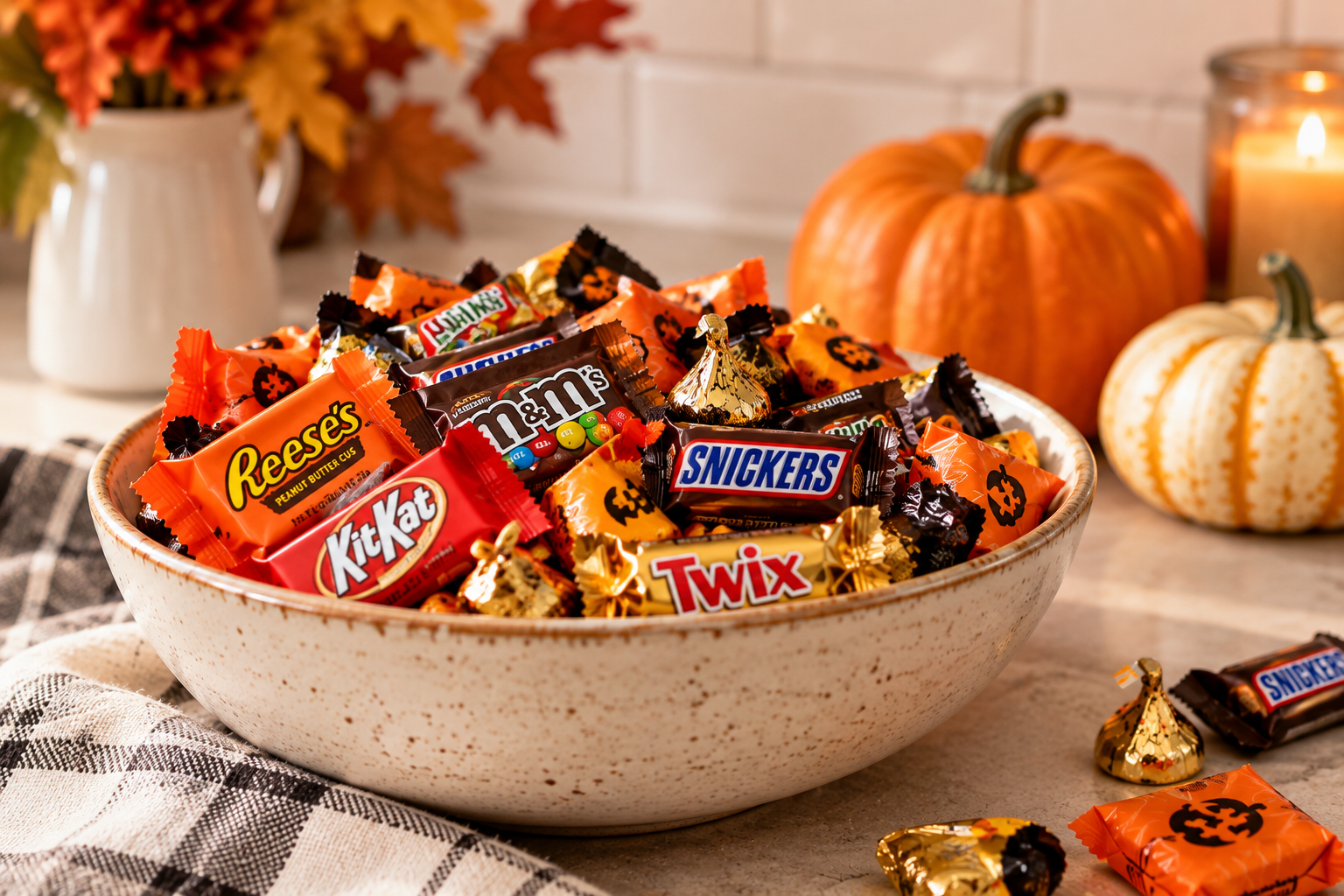
Halloween creates a nearly perfect environment for mindless eating.
Candy is highly visible, individually wrapped, easy to grab, and often available for days or weeks. You may walk past the candy bowl dozens of times throughout the day.
And sometimes we aren't eating candy because we're particularly hungry or even because we really want it.
We eat it because it's there.
Research on mindfulness-based eating interventions suggests that increasing awareness during eating may help reduce external eating, impulsive food choices, energy intake, and sweet intake while improving awareness of fullness.
In other words, one of the most useful questions you can ask yourself isn't:
“Am I allowed to eat this?”
It might be:
“Do I actually want this right now?”
Those are two very different questions.
1. Give Yourself Permission to Eat Candy
This might sound counterintuitive.
If you're worried about overeating candy, shouldn't you try harder to avoid it?
Not necessarily.
Labeling foods as completely off-limits can make our relationship with them more complicated. Research examining dietary restraint and binge eating is nuanced, and dietary restraint itself does not automatically cause overeating. However, rigid rules, emotional factors, and the way we think about restricted foods can all influence eating behavior.
An intuitive-eating approach instead encourages us to move away from moralizing food as "good" or "bad."
Candy isn't "bad."
Broccoli isn't "good."
They're simply foods that provide different nutrients, experiences, and purposes in our overall eating pattern.
Giving yourself permission to enjoy Halloween candy doesn't mean eating unlimited amounts of it. It means removing some of the urgency surrounding it.
Instead of thinking:
“I better eat all of this tonight because tomorrow I'm getting back on track.”
Try:
“I can have candy again whenever I want it. I don't need to eat all of it right now.”
That small mindset shift can be powerful.
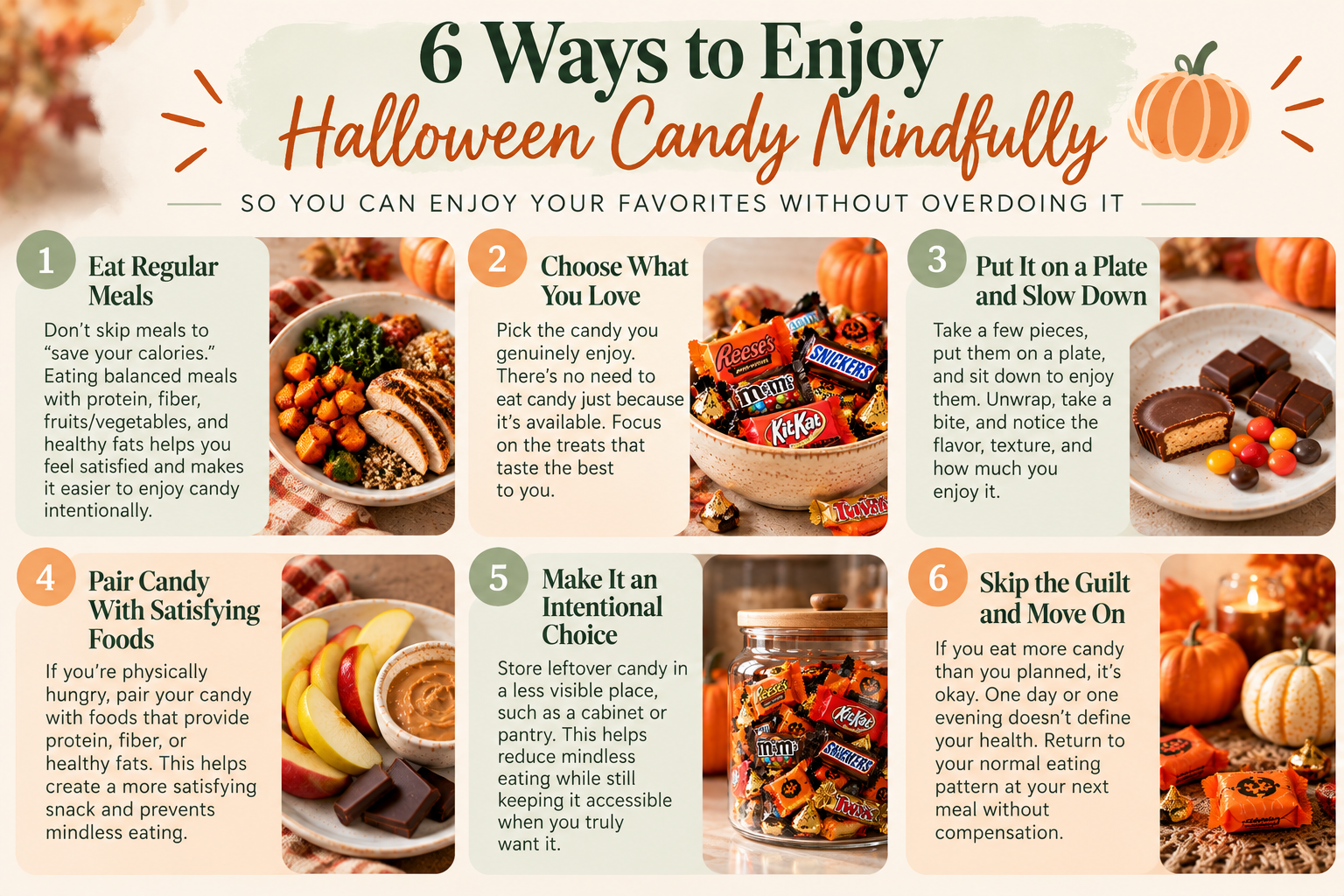
2. Don't "Save Your Calories" for Halloween Candy
It can be tempting to eat very little during the day because you know you'll have candy later.
But arriving at a Halloween party, or sitting down next to the candy bowl, extremely hungry makes intentional eating much harder.
You don't need to compensate for candy by skipping meals.
Continue eating your normal meals throughout the day.
Ideally, build meals around foods that provide:
Protein
Fiber-rich carbohydrates
Fruits and/or vegetables
Healthy fats
For example, lunch might include chicken, roasted vegetables, potatoes, and avocado.
You're not trying to make yourself so full that you can't eat candy. You're simply giving your body adequate nourishment so that you aren't making every food decision while extremely hungry.
Candy can then be something you enjoy, rather than something you feel desperate to eat.
3. Choose the Candy You Actually Like
You don't have to eat candy just because it's available.
Think about which Halloween candy you genuinely enjoy.
Reese's?
Snickers?
Kit Kats?
Peanut M&M's?
Sour Patch Kids?
Whatever your favorites are, choose those.
If you take a piece of candy and realize you don't actually like it very much, you don't have to finish it simply because you opened it.
This is one of the principles behind mindful eating: paying attention to the actual experience of eating rather than eating automatically.
Ask yourself:
Does this actually taste good?
Am I enjoying it?
Would I choose this if it weren't sitting in front of me?
You might discover that some candy is absolutely worth eating and some isn't.
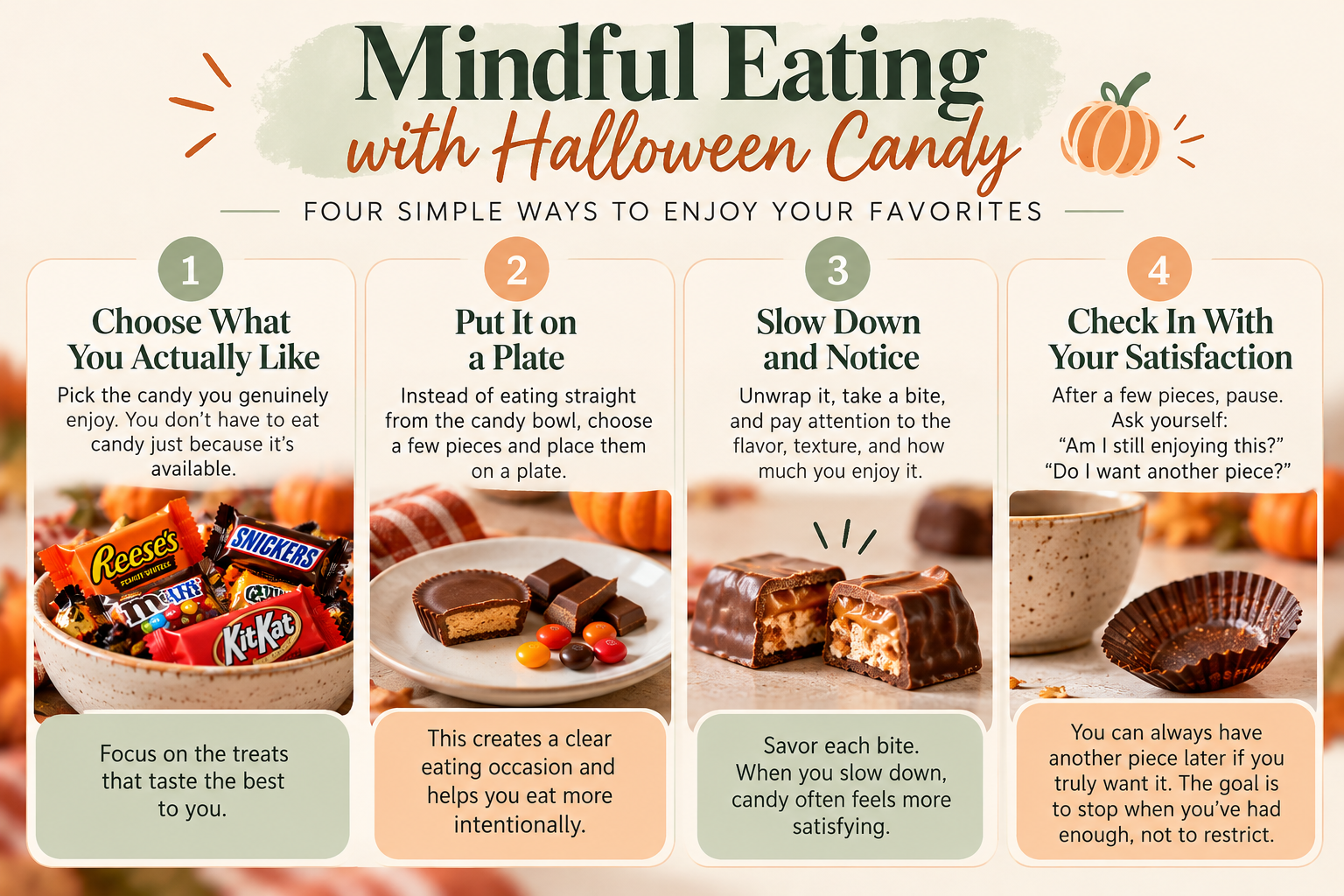
4. Put the Candy on a Plate
There's a big difference between intentionally choosing three pieces of candy and repeatedly reaching into a Halloween bowl while watching television.
Try taking the candy you'd like to eat and putting it on a plate or napkin.
Then sit down and enjoy it.
This creates a clear eating occasion rather than turning candy into something you graze on continuously.
It also gives you an opportunity to actually notice what you're eating.
And if you finish those pieces and genuinely want another one?
You can have another one.
The goal isn't to create another rigid rule. It's to put a small pause between wanting something and automatically eating it.
5. Slow Down Enough to Taste It
Halloween candy disappears quickly when we're distracted.
Unwrap it.
Take a bite.
Notice the texture.
Notice the flavor.
Ask yourself how satisfying it actually is.
Mindfulness-based interventions have been studied extensively in relation to eating behavior. Meta-analyses suggest these interventions can improve several eating-related behaviors, including awareness of fullness, external eating, impulsive food choices, and overall energy intake.
A 2026 systematic review and meta-analysis also found that mindfulness and mindful-eating interventions produced a modest reduction in food intake overall, although effects tended to be larger in controlled laboratory environments than in real-world settings.
Mindful eating isn't about eating incredibly slowly or turning every piece of chocolate into a meditation exercise.
It's simply about being present enough to realize:
I'm eating this, I like it, and I'm satisfied.
6. Pair Candy With Something More Filling
Sometimes you want candy but you're also physically hungry.
Candy can certainly provide energy, but most candy contains relatively little protein or fiber.
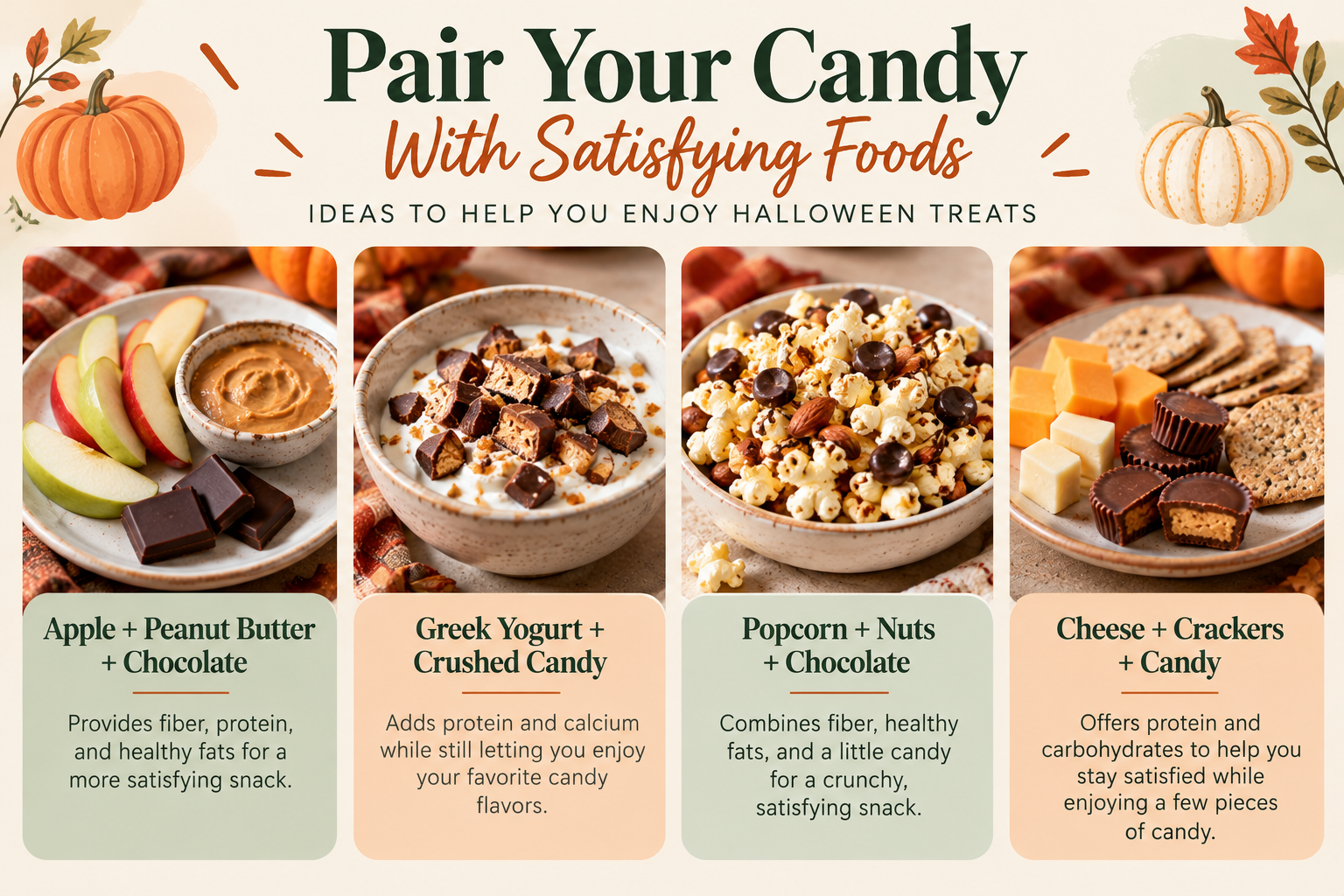
Instead of expecting a few mini candy bars to satisfy a hungry stomach, pair the candy with something more substantial.
Try:
Apple + peanut butter + a few pieces of chocolate
Greek yogurt + crushed Halloween candy
Cheese + crackers + your favorite candy
Popcorn + peanuts + a few pieces of chocolate
A balanced dinner followed by Halloween candy for dessert
You're still eating the candy.
You're simply also giving your body nutrients that help create a more satisfying eating experience.
7. Check In With Yourself Before Going Back for More
You don't need to count exactly how many pieces of candy you're "allowed" to eat.
Instead, pause.
Ask yourself:
Am I still physically hungry?
Am I still enjoying this?
Do I want another piece because it tastes good, or am I eating it because it's sitting here?
Would another piece make this experience better?
Sometimes the answer will be yes.
Have another piece.
Other times you may realize that the first few pieces were fantastic and the next several aren't adding much enjoyment.
That's satisfaction.
Learning to recognize satisfaction can be just as valuable as learning to recognize fullness.
8. Store Leftover Candy Somewhere Less Visible
Giving yourself permission to eat candy doesn't mean it has to sit directly in front of you all day.
Food cues in our environment can influence eating behavior, particularly when we're distracted or eating automatically.
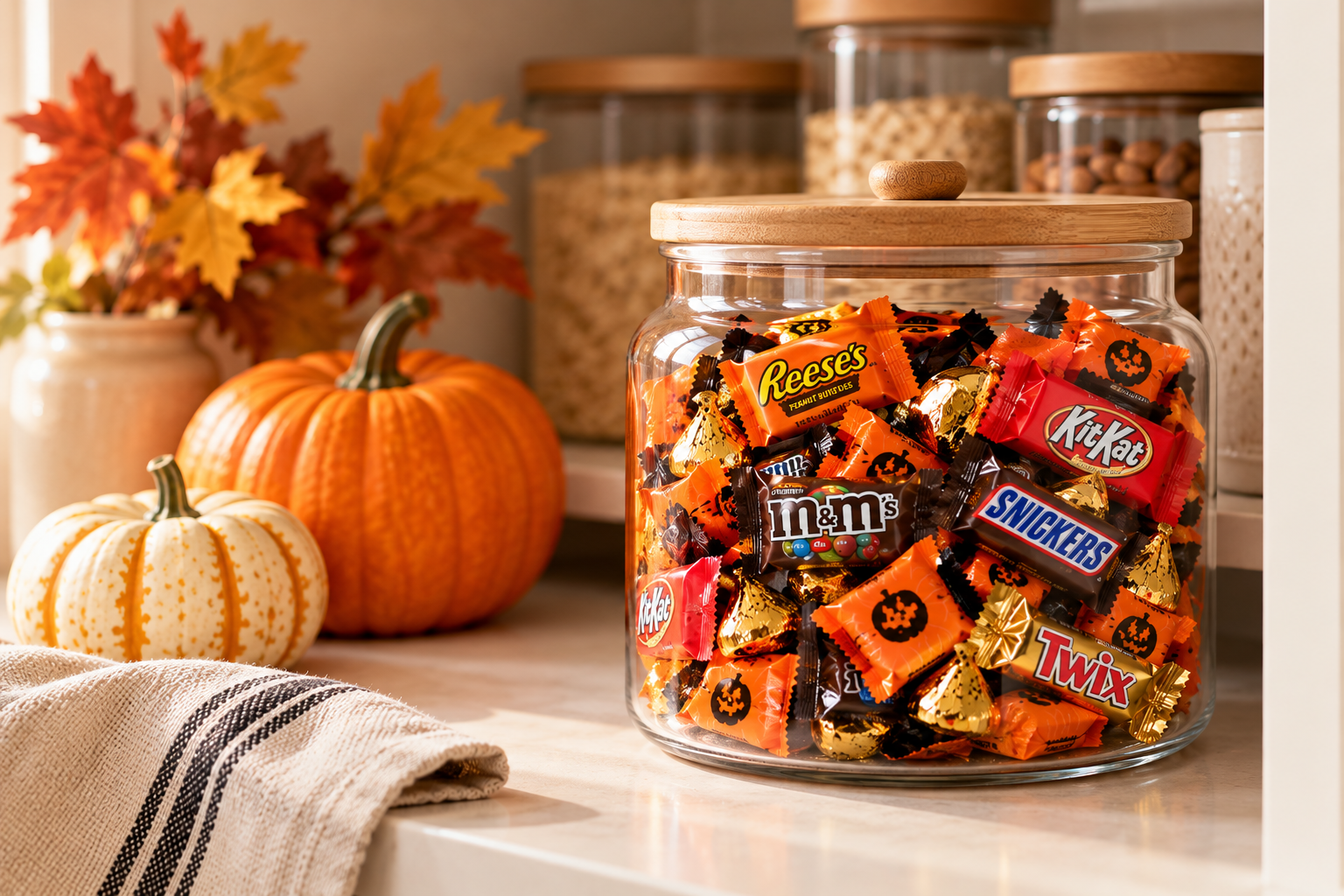
After Halloween, consider putting leftover candy in a cabinet, pantry, or container rather than keeping a giant bowl on the kitchen counter.
You're not hiding it because you "can't control yourself."
You're simply creating an environment where eating candy becomes an intentional choice rather than a response to seeing it every time you walk through the kitchen.
You still know where it is.
You can still have some whenever you want it.
9. Don't Compensate the Next Day
Maybe you ate more candy than you intended.
It happens.
You don't need to:
Skip breakfast.
Cut carbohydrates.
Spend two hours exercising.
Avoid sugar for the next week.
Start a cleanse.
Promise yourself you'll "be good" tomorrow.
Just return to your normal eating pattern.
One evening of eating more than usual does not require punishment or compensation.
Your overall health is influenced by the patterns you practice repeatedly, not a handful of fun-size candy bars on Halloween.
What If You Do Overeat?
First, get curious instead of judgmental.
Ask yourself:
Was I extremely hungry?
Had I been restricting candy beforehand?
Was I distracted?
Was I stressed, tired, or emotional?
Was I eating candy I actually enjoyed?
Did I feel like I needed to eat everything because I planned to restrict it again tomorrow?
These questions provide much more useful information than:
“Why don't I have more willpower?”
Research on intuitive eating consistently finds associations with healthier psychological outcomes and fewer disordered-eating behaviors. A meta-analysis of 97 studies found intuitive eating was inversely associated with multiple measures of eating pathology and body-image disturbance.
The goal isn't perfection.
The goal is learning how to respond to your body's cues and learning from eating experiences without turning them into evidence that you've "failed."
Halloween Candy Can Fit Into a Healthy Diet
Nutrition doesn't have to exist at one of two extremes.
You don't have to choose between:
Eating perfectly
and
Eating the entire Halloween candy bowl.
There's a huge amount of space between those two options.
You can eat vegetables.
You can prioritize protein.
You can exercise.
You can work toward improving your blood sugar, cholesterol, athletic performance, or overall health.
And you can eat a Reese's Peanut Butter Cup on Halloween.
Those things can exist together.
Healthy eating isn't about eliminating every food that doesn't provide optimal nutrition. It's about creating an overall eating pattern that supports your health while still leaving room for enjoyment, traditions, celebrations, and foods you simply love.
This Halloween, instead of asking yourself:
“How do I avoid eating candy?”
Try asking:
“How can I enjoy the candy I really like, pay attention while I'm eating it, and stop when I've had enough?”
That's a skill you can use long after Halloween is over.
References
Ahmadyar, K., Zhang, Q., Ferriday, D., Hinton, E. C., Robinson, E., Jones, A., Bogosian, A., Chen, G., & Tapper, K. (2026). Effects of mindfulness and mindful eating on food intake and appetite: A systematic review and meta-analysis. Clinical Psychology Review, 128, 102780. https://doi.org/10.1016/j.cpr.2026.102780
Babbott, K. M., Cavadino, A., Brenton-Peters, J., Consedine, N. S., & Roberts, M. (2023). Outcomes of intuitive eating interventions: A systematic review and meta-analysis. Eating Disorders, 31(1), 33–63. https://doi.org/10.1080/10640266.2022.2030124
Godfrey, K. M., Gallo, L. C., & Afari, N. (2015). Mindfulness-based interventions for binge eating: A systematic review and meta-analysis. Journal of Behavioral Medicine, 38(2), 348–362. https://doi.org/10.1007/s10865-014-9610-5
Grohmann, D., & Laws, K. R. (2021). Two decades of mindfulness-based interventions for binge eating: A systematic review and meta-analysis. Journal of Psychosomatic Research, 149, 110592. https://doi.org/10.1016/j.jpsychores.2021.110592
Hensley-Hackett, K., Bosker, J., Keefe, A., Reidlinger, D., Warner, M., D'Arcy, A., & Utter, J. (2022). Intuitive eating intervention and diet quality in adults: A systematic literature review. Journal of Nutrition Education and Behavior, 54(12), 1099–1115. https://doi.org/10.1016/j.jneb.2022.08.008
Liu, J., Tynan, M., Mouangue, A., Martin, C., Manasse, S., & Godfrey, K. (2025). Mindfulness-based interventions for binge eating: An updated systematic review and meta-analysis. Journal of Behavioral Medicine, 48(1), 57–89. https://doi.org/10.1007/s10865-025-00550-5
Linardon, J., Tylka, T. L., & Fuller-Tyszkiewicz, M. (2021). Intuitive eating and its psychological correlates: A meta-analysis. International Journal of Eating Disorders, 54(7), 1073–1098.
This article is for educational purposes and is not a substitute for individualized medical or nutrition advice. If you regularly experience loss-of-control eating, binge eating, or significant anxiety surrounding food, consider working with a registered dietitian and/or qualified mental health professional.
