Protein Powder: Do You Actually Need It? A Dietitian Explains
Walk through the supplement aisle or scroll through social media and it can feel like protein powder is practically a requirement for being healthy, building muscle, or reaching your fitness goals.
Whey protein. Plant protein. Collagen. Casein. Grass-fed. Isolate. Concentrate. Twenty-five grams of protein. Forty grams of protein.
With so many choices and so much marketing, it is easy to wonder:
Do you actually need protein powder?
For most people, the answer is no.
Protein powder isn't a nutritional necessity. It is simply a convenient way to help meet your protein needs when getting enough protein from food is difficult, inconvenient, or unrealistic.
Let's look at what the research actually tells us about protein needs, when protein powder might be useful, and if you decide to use one, how to choose a quality product.
First: Why Do We Need Protein?
Protein is much more than something people eat to build muscle.
Dietary protein supplies amino acids that your body uses for countless functions, including:
Building and repairing muscle
Maintaining muscle mass as you age
Producing enzymes and hormones
Supporting immune function
Recovering from exercise and injury
Maintaining tissues throughout the body
Your body is constantly breaking down and rebuilding proteins, which means protein needs to be consumed regularly through your diet.
But protein powder isn't inherently better protein.
Chicken, fish, eggs, Greek yogurt, cottage cheese, milk, soy foods, beans, lentils, nuts, seeds and many other foods can all contribute toward your daily protein intake.
Protein powder simply packages protein into a convenient, concentrated form.
How Much Protein Do You Actually Need?
This is where things get more nuanced.
The Recommended Dietary Allowance (RDA) for healthy adults is 0.8 grams of protein per kilogram of body weight per day.
For example, a 150-pound person weighs approximately 68 kilograms:
68 kg × 0.8 g/kg = about 54 grams of protein per day.
However, the RDA is intended to cover the basic needs of nearly all healthy adults. It should not necessarily be interpreted as the optimal amount for every individual or every goal.
People who exercise regularly, particularly those performing resistance training, may benefit from considerably more.
Research and sports-nutrition guidelines generally support approximately 1.4–2.0 g/kg/day for exercising individuals, depending on training, energy intake, goals and other factors.
A large systematic review and meta-analysis involving 49 studies and 1,863 participants found that protein supplementation alongside resistance training modestly improved gains in fat-free mass and strength. Importantly, the benefit appeared to level off around a total daily protein intake of approximately 1.6 g/kg/day.
In other words:
More protein is not automatically better.
Once your overall needs are being met, adding another protein shake does not necessarily translate into additional muscle.
What About Protein as We Age?
Protein becomes especially important as we get older.
Aging is associated with changes in the body's response to dietary protein, sometimes referred to as anabolic resistance. This means older adults may require a larger protein stimulus to support muscle protein synthesis and help preserve lean tissue.
The PROT-AGE Study Group recommends approximately 1.0–1.2 g/kg/day for healthy adults over 65, with ≥1.2 g/kg/day often appropriate for physically active older adults. Needs may be higher during illness or other catabolic conditions.
This does not mean everyone over 65 needs a protein shake.
It means that meeting protein needs becomes increasingly important and protein powder can sometimes make doing that easier.
So, Do You Need Protein Powder?
Probably not.
If you're consistently meeting your protein needs through food, there is no physiological requirement to add protein powder.
Think of protein powder as a convenience food rather than a requirement.
You might find protein powder helpful if:
You struggle to meet your protein needs through food alone.
You have a high protein target because of your training.
You don't have much appetite in the morning.
You need a quick post-workout option.
You're traveling or frequently eating on the go.
You eat a vegetarian or vegan diet and struggle to consistently include enough protein.
You are an older adult having difficulty consuming enough protein.
You're in a calorie deficit and want a relatively low-calorie source of protein.
Preparing another protein-containing meal simply isn't realistic for your schedule.
On the other hand, if you're already meeting your protein needs with meals and snacks, adding a protein shake simply because you feel like you're "supposed to" probably isn't necessary.
Food First But, Not Food Only
You've probably heard the phrase "food first."
That's generally a useful philosophy, but it doesn't need to become another nutrition rule.
Whole-food protein sources often provide nutrients beyond protein itself.
For example:
Greek yogurt provides protein along with calcium and other nutrients.
Salmon provides protein alongside omega-3 fatty acids.
Beans and lentils provide protein, fiber, carbohydrates, vitamins, minerals and phytochemicals.
Eggs provide high-quality protein along with several vitamins, minerals and other bioactive nutrients.
Protein powder typically doesn't offer that same nutritional package.
But convenience matters too.
If adding a scoop of protein powder to oatmeal makes breakfast go from 10 grams of protein to 30 grams or a shake prevents you from regularly skipping breakfast, protein powder can be a perfectly reasonable tool.
Nutrition doesn't have to be all-or-nothing.
How Much Protein Should You Eat at One Time?
You don't need to obsess over an exact number, but spreading protein throughout the day can be useful.
For exercising individuals, research-based recommendations commonly suggest approximately 20–40 grams of high-quality protein per meal or feeding, although individual needs vary according to body size, age, activity and total daily protein requirements.
Rather than eating very little protein at breakfast and lunch and trying to make up for everything at dinner, consider distributing protein across your day.
For example:
Breakfast: 25–30 g
Lunch: 25–35 g
Snack: 15–25 g
Dinner: 30–40 g
The exact numbers don't need to look like this.
Your overall protein intake matters more than perfectly timing a shake within a tiny post-workout "anabolic window."
Whey, Casein or Plant Protein: Does It Matter?
There are several different types of protein powder.
Whey Protein
Whey is a milk-derived protein that contains all nine essential amino acids and is particularly rich in leucine, an amino acid involved in stimulating muscle protein synthesis.
You'll commonly see:
Whey concentrate: Contains protein along with varying amounts of lactose, carbohydrate and fat.
Whey isolate: More highly filtered and generally contains a greater percentage of protein with less lactose, carbohydrate and fat.
Whey is an excellent option for people who tolerate dairy.
Casein Protein
Casein is another milk protein, but it digests more slowly than whey.
That doesn't necessarily make it better or worse it is simply another high-quality protein option.
Soy Protein
Soy is one of the strongest plant-based options because it provides all essential amino acids and can be an excellent choice for someone avoiding dairy or eating a plant-based diet.
Pea and Other Plant Proteins
Pea, rice, hemp and blended plant proteins can also help meet protein needs.
Some individual plant proteins contain lower amounts of certain essential amino acids than animal-derived proteins. Blended products can help provide a more balanced amino-acid profile.
Ultimately, total protein intake and overall dietary pattern matter more than finding the "perfect" protein powder.
What About Collagen Protein?
This deserves an important distinction.
Collagen powder should not be considered equivalent to whey, soy or other complete proteins for supporting muscle growth.
Collagen has a different amino-acid profile and is relatively low in essential amino acids important for stimulating muscle protein synthesis.
Collagen may have other potential applications, including research examining connective tissue, skin or joint health, but if your primary goal is increasing your protein intake or supporting muscle growth, I would generally choose a complete protein source instead.
The Bigger Issue: What's Actually in Your Protein Powder?
This is arguably more important than deciding between chocolate whey and vanilla pea protein.
Dietary supplements are regulated differently from medications in the United States.
The FDA does not approve dietary supplements for safety and effectiveness before they reach the market.
Manufacturers are responsible for ensuring that their products are safe and appropriately labeled.
That is one reason I recommend looking for independent third-party testing when purchasing supplements.
Third-party certification doesn't necessarily mean that a supplement is more effective.
Instead, it provides additional assurance that the product contains what it claims to contain and has been evaluated according to the standards of the certifying organization.
What Does "Third-Party Tested" Actually Mean?
Not all third-party programs evaluate products in exactly the same way.
Here are several names you may encounter.
NSF Certified for Sport®
NSF Certified for Sport is one of my preferred certifications, particularly for athletes.
NSF evaluates products through processes that include:
Product testing
Label and formulation review
Manufacturing facility and supplier inspections
Ongoing monitoring
Screening for prohibited athletic substances
NSF reports screening Certified for Sport products for more than 290 banned substances, including stimulants, steroids, narcotics, diuretics and masking agents.
This is especially important for collegiate, professional or other drug-tested athletes.
Look for:
NSF Certified for Sport®
You can also search the official NSF Certified for Sport database before purchasing a product.
USP Verified
USP (the United States Pharmacopeia) also operates an independent supplement verification program.
According to USP, products carrying the USP Verified mark have been evaluated to confirm that they:
Contain the ingredients listed on the label in the declared amounts
Do not contain harmful levels of specified contaminants
Meet manufacturing standards
Meet specified performance standards
One important clarification:
"USP Verified" is different from a company saying that an ingredient is "USP grade" or "meets USP standards."
Look for the actual USP Verified mark on the finished product.
USP certification is excellent, but you're less likely to encounter USP Verified protein powders than NSF-certified products. USP's program is commonly seen on vitamins and other dietary supplements.
ConsumerLab
ConsumerLab works somewhat differently.
Rather than functioning solely as a certification seal you look for at the store, ConsumerLab independently purchases and tests supplements and publishes its findings for consumers.
Testing can include evaluation of:
Whether the listed amount of an ingredient is actually present
Contamination
Label accuracy
Other product-specific quality measures
And this matters.
In ConsumerLab's 2026 evaluation of protein powders and ready-to-drink shakes, all tested products contained their claimed amounts of protein, but 6 of 21 independently selected products failed ConsumerLab's quality criteria because they contained significantly more sodium, sugar or cholesterol than their labels indicated.
Testing also identified differences in heavy-metal exposure among products, although none exceeded ConsumerLab's general safety limits for heavy metals.
The takeaway isn't that protein powder is dangerous.
It is that a polished label and expensive price tag don't guarantee superior quality.
Informed Sport / Informed Choice
Another certification you may encounter is Informed Sport, particularly with products marketed toward competitive athletes.
Like NSF Certified for Sport, these programs focus heavily on reducing the risk of prohibited substances in sports supplements.
For competitive athletes subject to drug testing, I would prioritize products carrying a sport-specific certification such as NSF Certified for Sport or Informed Sport.
What Should You Look for in a Protein Powder?
Instead of buying whichever container has the best marketing, turn it around and read the label.
Here's my checklist:
✓ Around 20–30 grams of protein per serving
You don't necessarily need 40, 50 or 60 grams in a shake.
Choose the amount based on what you're eating during the rest of the day.
✓ A protein source that works for you
Examples include:
Whey isolate
Whey concentrate
Casein
Soy
Pea protein
Plant-protein blends
✓ A relatively simple ingredient list
A long ingredient list isn't automatically bad, but ask yourself whether you actually need everything that's included.
Protein powders sometimes contain additional herbs, "superfood" blends, stimulants or other supplements that you may not need.
✓ Third-party verification
Look for programs such as:
NSF Certified for Sport®
USP Verified
Informed Sport
You can also check independent testing through ConsumerLab.
✓ An appropriate amount of added sugar
Protein powder doesn't need to be completely sugar-free, but check whether you're purchasing primarily a protein supplement or essentially a dessert mix.
✓ Something you actually enjoy
This part matters.
The nutritionally "perfect" protein powder isn't useful if you hate the taste and never use it.
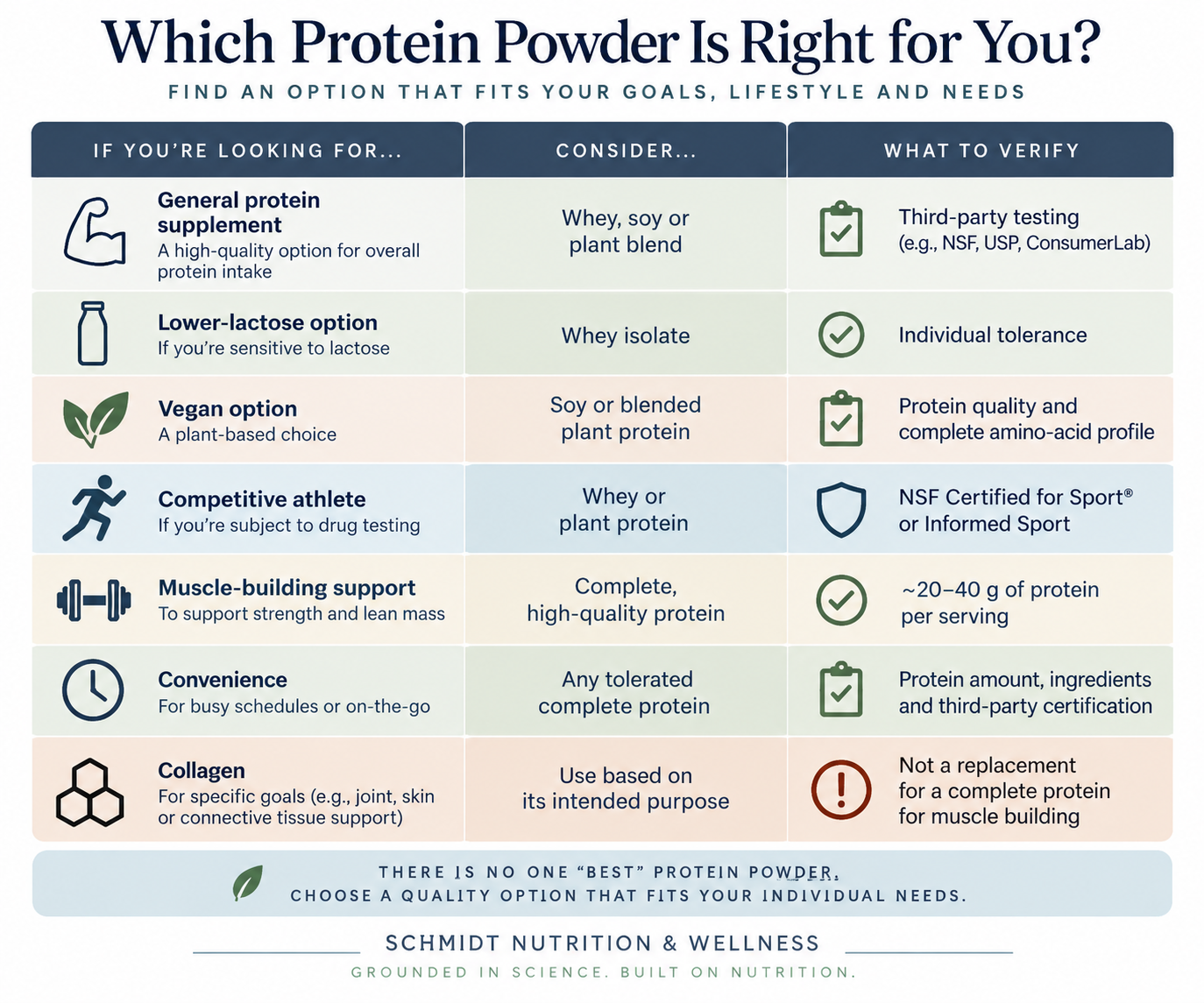
Which Protein Powder Is Right for You?
With so many options available, you don't need to find the one "best" protein powder. Instead, look for a product that fits your individual needs, preferences, budget, and goals.
Some Protein Powders Worth Investigating
Rather than giving one universal "best protein powder," I recommend choosing based on dietary needs, budget, taste and certification.
Because certifications and individual product formulations can change, always verify the exact product and flavor in the certifying organization's database before purchasing.
NSF Certified for Sport Options
The NSF Certified for Sport database includes multiple protein powders from brands and product lines such as:
Muscle Milk protein powders
ATHLEAN-RX PRO-30G
PODIUM whey protein
Wegmans Pasture Raised Protein Powder
Several additional whey and plant-based protein products
The NSF database is particularly useful because certification applies to specific products, not simply an entire brand.
That distinction matters.
A company may sell ten supplements while only three carry NSF certification.
ConsumerLab-Tested Options
ConsumerLab's 2026 protein review evaluated products including:
Optimum Nutrition Gold Standard 100% Whey
Isopure Zero Carb Protein
Naked Whey
NOW Sports Pea Protein
Orgain Organic Protein
Thorne Whey Protein Isolate
Transparent Labs 100% Grass-Fed Whey
Garden of Life Raw Organic Protein
Levels Grass Fed Whey
NorCal Organic Pea Protein
Nutricost Whey Protein Isolate
Sunwarrior Warrior Blend
Truvani Plant Based Protein
Ascent 100% Whey
Being tested by ConsumerLab does not automatically mean that a product passed or is a ConsumerLab Top Pick. Their complete ratings and Top Picks should be checked directly through their current report.
That distinction is important whenever someone claims a product is "ConsumerLab tested."
What About "Clean," "Natural" and "Grass-Fed" Protein?
These words can sound reassuring, but they aren't necessarily the characteristics I would prioritize when choosing a protein powder.
A product being marketed as:
"clean"
"natural"
"premium"
"grass-fed"
"doctor formulated"
does not automatically tell you whether the product contains the amount of protein stated on the label or whether it has been independently tested for contaminants.
Instead of relying on front-of-package marketing, look at:
Protein content → ingredients → added sugar → third-party certification → cost → taste.
Those factors usually tell you far more.
Does More Expensive Mean Better?
No.
Price does not guarantee quality.
ConsumerLab's recent testing found substantial differences in cost between protein products, but paying more did not necessarily mean getting a higher-quality product.
That's another reason I recommend choosing protein powder based on your needs and independent quality verification, rather than branding.
Who Should Be More Cautious With Protein Supplements?
Protein powders can be convenient, but they're not appropriate for everyone without additional consideration.
Speak with your physician and/or registered dietitian if you have:
Chronic kidney disease
Certain liver conditions
Significant food allergies
Gastrointestinal conditions affecting tolerance or absorption
A medical condition requiring protein restriction
Pregnancy or breastfeeding concerns regarding supplemental ingredients
Medications or medical conditions that could interact with additional ingredients in a supplement
Also pay particular attention to protein powders containing much more than protein.
Herbal blends, stimulants, vitamins, minerals and other supplements can introduce additional considerations that wouldn't exist with a simple whey or plant protein powder.
The Bottom Line
You don't need protein powder to eat enough protein, build muscle or be healthy.
You can absolutely meet your protein needs through food.
But that doesn't mean protein powder is bad or unnecessary for everyone.
Protein powder can be an incredibly convenient tool when it helps bridge the gap between the amount of protein you're currently eating and the amount that supports your individual needs and goals.
Instead of asking:
"Should I be taking protein powder?"
Try asking:
"Am I currently meeting my protein needs and would protein powder make doing that easier?"
If the answer is yes, there's nothing wrong with using it.
Just remember that supplements aren't all created equal.
Choose a protein source you tolerate, check the nutrition and ingredient labels, and whenever possible, look for reputable independent verification such as NSF Certified for Sport, USP Verified, Informed Sport or independent testing through ConsumerLab.
Protein powder is a tool.
It doesn't need to be a requirement and it doesn't need to be feared.
References
Baum, J. I., Kim, I.-Y., & Wolfe, R. R. (2016). Protein consumption and the elderly: What is the optimal level of intake? Nutrients, 8(6), 359. https://doi.org/10.3390/nu8060359
Bauer, J., Biolo, G., Cederholm, T., Cesari, M., Cruz-Jentoft, A. J., Morley, J. E., Phillips, S., Sieber, C., Stehle, P., Teta, D., Visvanathan, R., Volpi, E., & Boirie, Y. (2013). Evidence-based recommendations for optimal dietary protein intake in older people: A position paper from the PROT-AGE Study Group. Journal of the American Medical Directors Association, 14(8), 542–559. https://doi.org/10.1016/j.jamda.2013.05.021
Jäger, R., Kerksick, C. M., Campbell, B. I., Cribb, P. J., Wells, S. D., Skwiat, T. M., Purpura, M., Ziegenfuss, T. N., Ferrando, A. A., Arent, S. M., Smith-Ryan, A. E., Stout, J. R., Arciero, P. J., Ormsbee, M. J., Taylor, L. W., Wilborn, C. D., Kalman, D. S., Kreider, R. B., Willoughby, D. S., ... Antonio, J. (2017). International Society of Sports Nutrition position stand: Protein and exercise. Journal of the International Society of Sports Nutrition, 14, 20. https://doi.org/10.1186/s12970-017-0177-8
Morton, R. W., Murphy, K. T., McKellar, S. R., Schoenfeld, B. J., Henselmans, M., Helms, E., Aragon, A. A., Devries, M. C., Banfield, L., Krieger, J. W., & Phillips, S. M. (2018). A systematic review, meta-analysis and meta-regression of the effect of protein supplementation on resistance training-induced gains in muscle mass and strength in healthy adults. British Journal of Sports Medicine, 52(6), 376–384. https://doi.org/10.1136/bjsports-2017-097608
